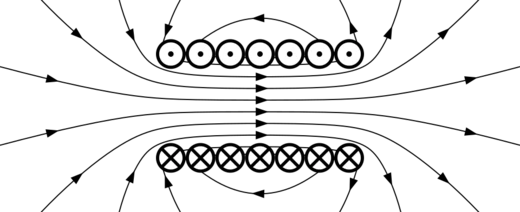
Lenz's law
Induced current opposes the change in magnetic flux.

Lenz's law is a fundamental principle in electromagnetism that describes the direction of an induced electric current resulting from a change in magnetic flux. It is a qualitative law that specifies direction but not magnitude, and is contained within Faraday's law of induction through a negative sign.
- field
- Electromagnetism
- known_for
- Formulating Lenz's law, which determines the direction of induced current
- nationality
- Not specified in source
- born
- Not specified in source
- died
- Not specified in source
Lore & Background
It states that the direction of the electric current induced in a conductor by a changing magnetic field is such that the magnetic field created by the induced current opposes changes in the initial magnetic field. The law is qualitative, specifying only the direction of induced current, not its magnitude. The law predicts the direction of many effects in electromagnetism, such as the direction of voltage induced in an inductor or wire loop by a changing current, or the drag force of eddy currents exerted on moving objects in a magnetic field. It is seen as analogous to Newton's third law in classical mechanics and Le Chatelier's principle in chemistry. An example of Lenz's law in action is demonstrated by dropping a strong magnet through a copper or aluminium pipe. The descent of the magnet inside the pipe is observably slower than when dropped outside, due to counter-rotating currents induced in the pipe that oppose the magnet's motion.
Reader's Guide
Lenz's law is significant because it provides the directional rule for electromagnetic induction, complementing Faraday's law which gives the magnitude of induced EMF. The law is expressed mathematically by the negative sign in Faraday's equation: E = -dΦ_B/dt, indicating that induced EMF opposes the change in magnetic flux. This principle underlies the operation of generators, inductors, and many electrical devices. The law also explains eddy current braking and the behavior of magnetic fields in conductors. Conservation of momentum in electromagnetic interactions involving Lenz's law requires accounting for momentum stored in the electromagnetic fields, as noted by physicist Richard Feynman and earlier by James Clerk Maxwell. The law's legacy lies in its fundamental role in understanding electromagnetic induction and its practical applications in technology.
Did You Know?
- The law is contained in Faraday's law of induction through the negative sign: E = -dΦ_B/dt.
- An example of Lenz's law is the slower descent of a magnet dropped through a copper or aluminium pipe compared to outside it.
- Lenz's law may be seen as analogous to Newton's third law in classical mechanics and Le Chatelier's principle in chemistry.
More in Electricity And Magnetism 1-24
Elsewhere in the Electricity And Magnetism universe
Spotted an error? Know more?
This is a living reference — every entry is fact-audited, and reader corrections feed straight into our audit queue. Suggest an edit · See this site's audit record