
Electrical conductor
Material enabling electric current flow via charge carriers.

MikeRun · CC BY-SA 4.0
In physics and electrical engineering, a conductor is an object or type of material that allows the flow of charge (electric current) in one or more directions. Materials made of metal are common electrical conductors. The flow of negatively charged electrons generates electric current, positively charged holes, and positive or negative ions in some cases. Conductors are essential for the operation of electrical circuits, enabling the transfer of energy from a current source to loads through a chain of momentum transfer between mobile charge carriers.
- field
- Physics and electrical engineering
- known_for
- Allowing flow of electric current; resistance proportional to length and inversely proportional to cross-sectional area
- key_materials
- Metals (copper, silver, aluminum), electrolytes, superconductors, semiconductors, plasmas, graphite, conductive polymers
- resistivity_formula
- R = ρℓ/A, where ρ is resistivity, ℓ is length, A is cross-sectional area
Lore & Background
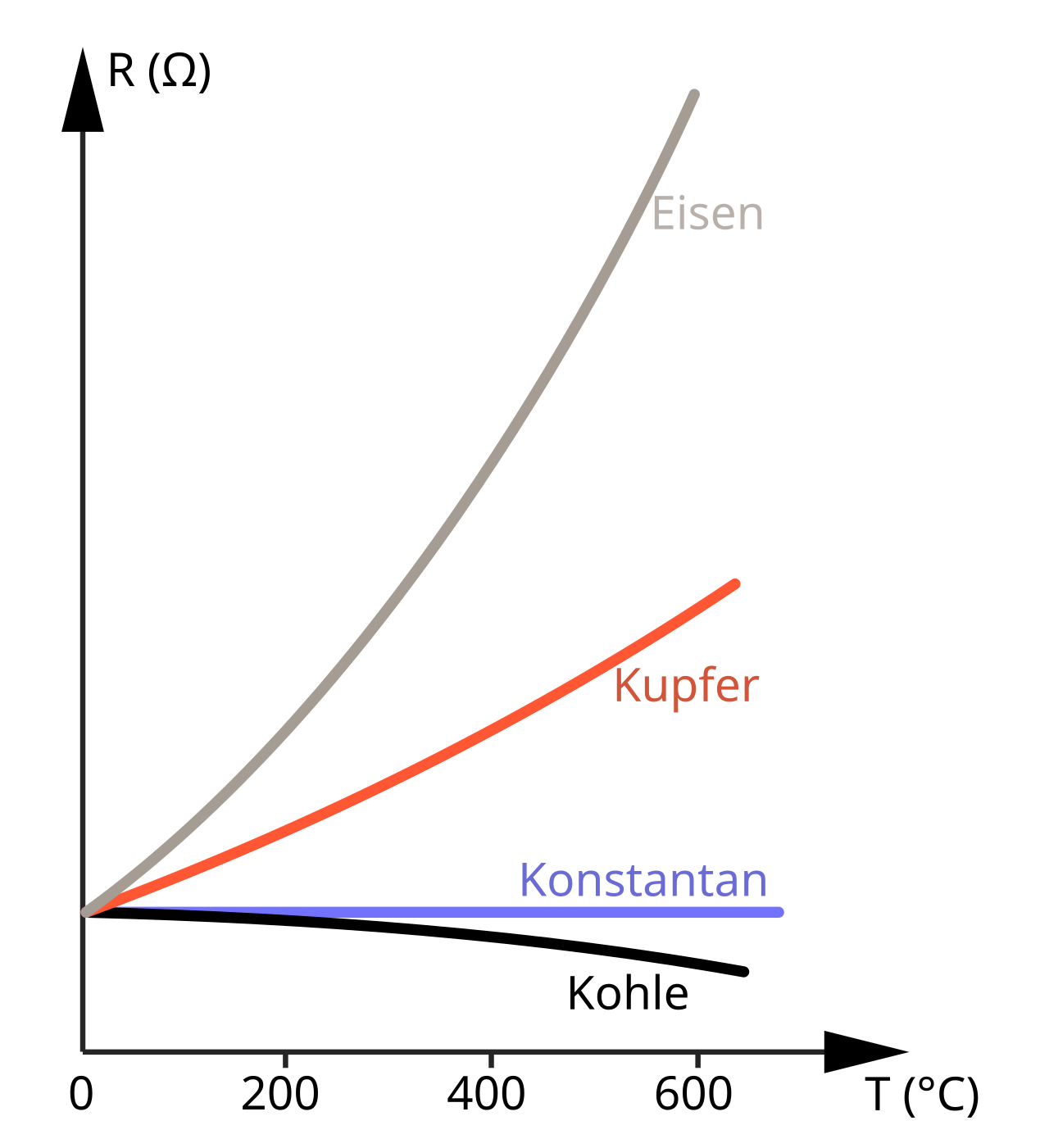
The resistance of a given conductor depends on the material it is made of and on its dimensions. For a given material, resistance is inversely proportional to cross-sectional area and proportional to length. The resistance R and conductance G of a uniform cross-section conductor are computed as R = ρℓ/A and G = σA/ℓ, where ρ is resistivity and σ is conductivity. Resistivity and conductivity are reciprocals (ρ = 1/σ) and depend only on the material, not geometry. This formula assumes uniform current density, which is not always the case in practical situations such as alternating current skin effect, where current flow near the conductor center is inhibited, increasing resistance. Temperature also affects conductors: materials expand under heat, changing geometry slightly, and increased temperature generates more phonons that scatter electrons, reducing current transfer.
Reader's Guide
Conductors are fundamental to electrical systems, with copper being the most common choice for light-gauge wires due to its affordability and high conductivity. Annealed copper is the international standard (58 MS/m), though silver is 6% more conductive but impractical due to cost, used only in specialized equipment like satellites or as thin plating to mitigate skin effect losses. Aluminum wire, despite having only 61% of copper's conductivity by cross-sectional area, is twice as conductive by mass and roughly one-third the cost, making it dominant in power transmission. However, aluminum's mechanical and chemical properties—forming insulating oxide, higher thermal expansion, and creep—require careful installation. Very few organic compounds conduct electricity; typical ones lack charge carriers, though ionic liquids and conductive polymers are exceptions. Pure water becomes a conductor with ionic impurities like salt. Wire size is measured by cross-sectional area (square millimeters, American wire gauge, or circular mils).
Did You Know?
- Silver is 6% more conductive than copper but is used only in specialized equipment due to cost.
- Aluminum wire is the most common metal in electric power transmission and distribution, being twice as conductive by mass as copper.
- Pure water is not an electrical conductor, but even a small portion of ionic impurities like salt can rapidly transform it into a conductor.
The Physics of Charge Transport
An electrical conductor is fundamentally a medium through which electric charge can travel in one or more directions. While metals are the most familiar examples, the carriers of that charge are not always electrons. In metallic conductors, negatively charged electrons serve as the primary movers, but other systems rely on different charge carriers: positively charged holes, positive or negative ions, the cationic electrolytes inside a battery, or even mobile protons in a fuel-cell proton conductor. What makes the process remarkable is that no single charged particle must journey from the current source all the way to the load. Instead, each particle merely nudges its neighbor a small distance, which nudges the next, creating a long relay of momentum transfer all the way to the consumer. The Drude model of conduction formalizes this picture. Metals are especially well suited to this role because they possess a delocalized sea of electrons whose mobility allows frequent collisions and efficient momentum handoff. By contrast, insulators contain so few mobile charges that they sustain only negligible currents.
Resistance, Conductance, and the Geometry of Wires
For a conductor of uniform cross-section, the relationship between resistance and geometry follows a clean mathematical pattern. Resistance is directly proportional to the conductor's length and inversely proportional to its cross-sectional area, captured by the expression R equals rho times length divided by area. Its reciprocal, conductance, is expressed as sigma times area divided by length. Here, length is measured in metres, cross-sectional area in square metres, conductivity (sigma) in siemens per metre, and resistivity (rho) in ohm-metres. Crucially, resistivity and conductivity are proportionality constants that depend solely on the material from which the wire is fashioned, not on its shape or size. They are reciprocals of one another: rho equals one over sigma. Resistivity, in particular, quantifies how strongly a given material opposes the passage of electric current. A practical illustration is straightforward: a thick copper wire will always offer less opposition to current than a thinner wire of the same material and length, while a long copper wire will always present higher resistance than a short one. The standard formula assumes current density is uniform throughout the conductor, an assumption that holds well for long, thin wires but breaks down in more complex practical scenarios.
AC Effects, Thermal Expansion, and Phonon Scattering
When alternating current flows through a conductor, the simple resistance formula begins to lose accuracy. The skin effect pushes current away from the conductor's core, meaning the effective cross-section in which charge actually travels is smaller than the physical cross-section. This raises the true resistance above what the basic formula predicts. A related phenomenon, the proximity effect, occurs when two conductors carrying AC sit close together; their mutual electromagnetic interaction further inflates each one's resistance. At commercial power frequencies, both effects become significant for large conductors handling substantial currents, such as the busbars inside an electrical substation or heavy power cables rated for several hundred amperes. Temperature introduces yet another layer of complexity. Heating a conductor causes it to expand or contract according to its thermal expansion coefficient, subtly altering its geometry and therefore its resistance, though this geometric shift is typically on the order of ten to the minus sixth. More importantly, rising temperature generates more phonons—essentially small harmonic vibrations of the atoms in the lattice. These vibrations scatter electrons, disrupting their paths and reducing the total current the conductor can deliver.
The Spectrum of Conduction Materials and Copper's Benchmark Role
The family of conduction materials extends well beyond ordinary metals. Electrolytes, superconductors, semiconductors, plasmas, and even certain nonmetallic substances such as graphite and conductive polymers all permit the flow of electric charge under appropriate conditions. Among metallic conductors, copper holds a position of near-universal reference. Annealed copper has been adopted as the international benchmark against which every other electrical conductor is measured; the International Annealed Copper Standard assigns it a conductivity of 58 megasiemens per metre, and ultra-pure copper variants can marginally exceed one hundred and one percent of that figure. For the vast majority of electrical applications—building wire, motor windings, power cables, and substation busbars—the grade of choice is electrolytic-tough pitch copper, identified by the designations CW004A or ASTM C100140. When a project demands that high-conductivity copper be welded, brazed, or exposed to a reducing atmosphere, engineers turn instead to oxygen-free high-conductivity copper, designated CW008A or ASTM C10100. Copper's ease of connection by soldering further cements its dominance across the electrical industry.
Gallery

Frequently Asked Questions
What is an electrical conductor in Electricity And Magnetism 1-24?
An electrical conductor is a material or object that permits electric charge to move freely through it in one or more directions. This movement of mobile charge carriers—most often electrons in metallic substances—is what we observe as electric current.
What materials are considered electrical conductors?
Metals such as copper, silver, and aluminum are the most commonly referenced conductors, but the category also extends to electrolytes, plasmas, graphite, semiconductors, superconductors, and certain conductive polymers.
How does an electrical conductor actually carry current?
When a voltage is applied, mobile charge carriers—negatively charged electrons, positively charged holes, or ions—drift through the material, passing momentum along a chain that moves energy from the source to the load. This collective drift of charges is what constitutes the electric current.
What factors determine a conductor's resistance?
A conductor's resistance scales directly with its length and inversely with its cross-sectional area, as captured by the formula R = ρℓ/A. The proportionality constant ρ (resistivity) is an intrinsic property of the material itself.
Why is the electrical conductor entry important in the Electricity And Magnetism series?
Conductors serve as the physical pathway that lets energy travel from a power source to whatever device needs it, making them the backbone of every electrical circuit. Without them, the entire framework of circuit analysis and electromagnetic engineering would have no medium to operate through.
More in Electricity And Magnetism 1-24
Elsewhere in the Electricity And Magnetism universe
Spotted an error? Know more?
This is a living reference — every entry is fact-audited, and reader corrections feed straight into our audit queue. Suggest an edit · See this site's audit record