
Electric potential energy
Potential energy from conservative Coulomb forces in charge configurations.

Inductiveload · Public domain
Electric potential energy is a form of potential energy measured in joules that results from conservative Coulomb forces and is associated with the configuration of a particular set of point charges within a defined system. An object may have electric potential energy by virtue of its own electric charge or its relative position to other electrically charged objects. The term 'electric potential energy' is used for systems with time-variant electric fields, while 'electrostatic potential energy' is used for systems with time-invariant electric fields.
- SI unit
- joule
- CGS unit
- erg (10⁻⁷ joules)
- Named after
- James Prescott Joule
- Related concept
- electrostatic potential energy
Lore & Background
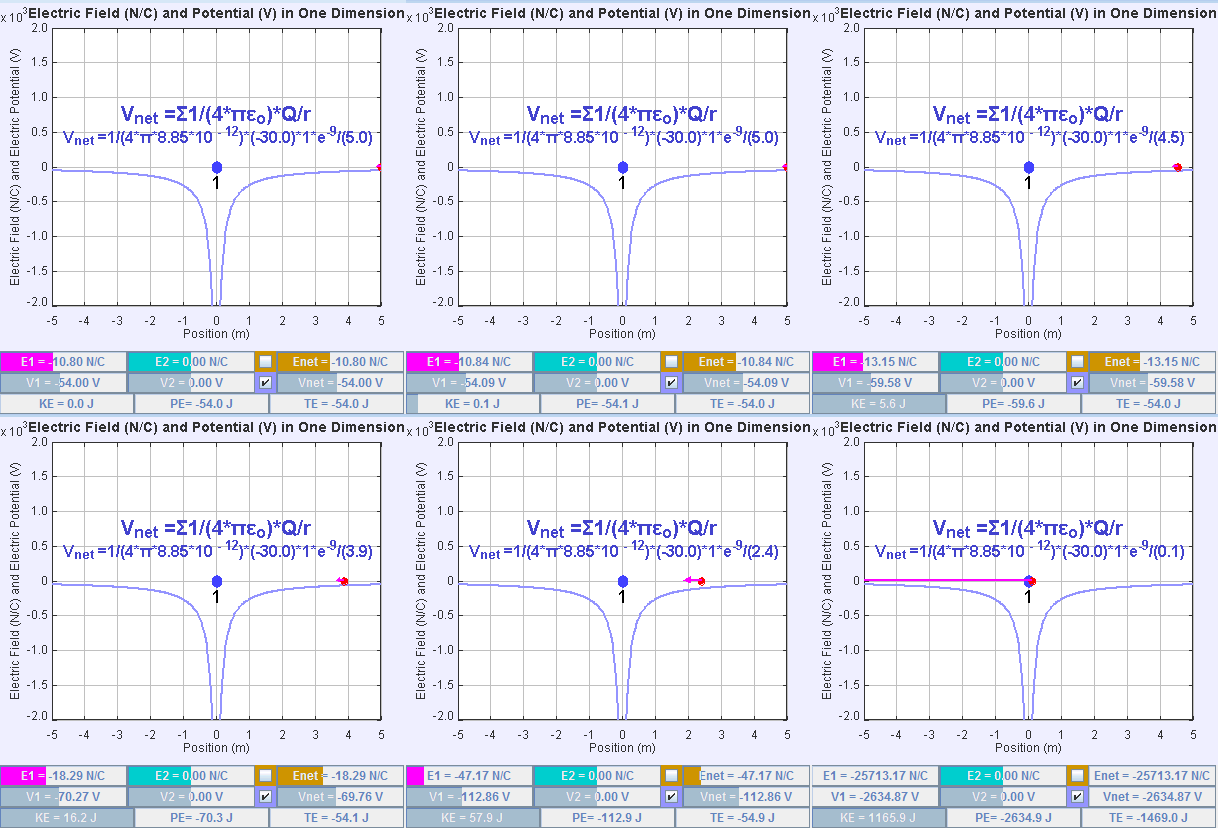
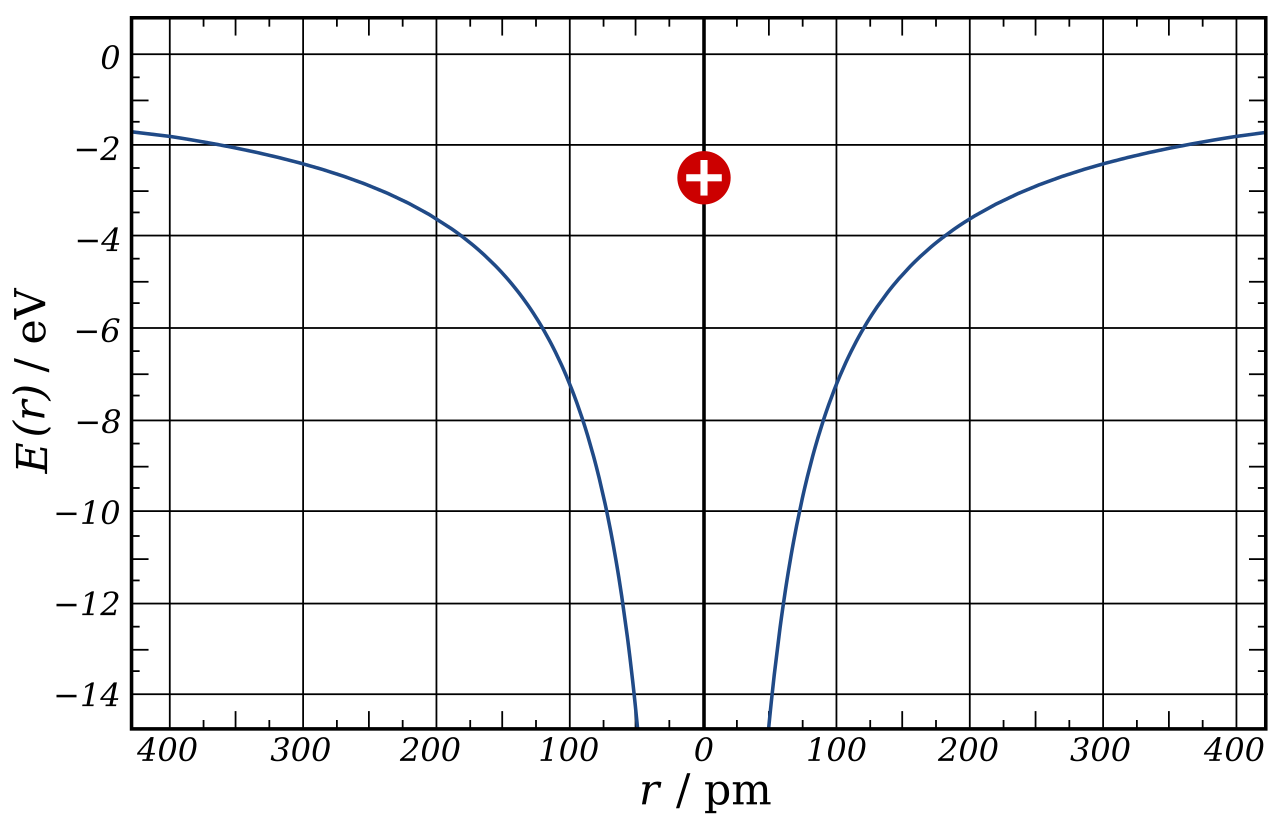
Electric potential energy is defined as the work required to assemble a system of point charges by bringing them from an infinite distance, or as the total work done by an external agent in bringing the charge or system of charges from infinity to its present configuration without acceleration. For one point charge q in the presence of another point charge Q, the electrostatic potential energy is given by U_E(r) = (1/(4πε₀)) (qQ/r), where r is the distance between them. For one point charge q in the presence of n point charges Q_i, the formula is U_E(r) = (q/(4πε₀)) Σ (Q_i / r_i).
Reader's Guide
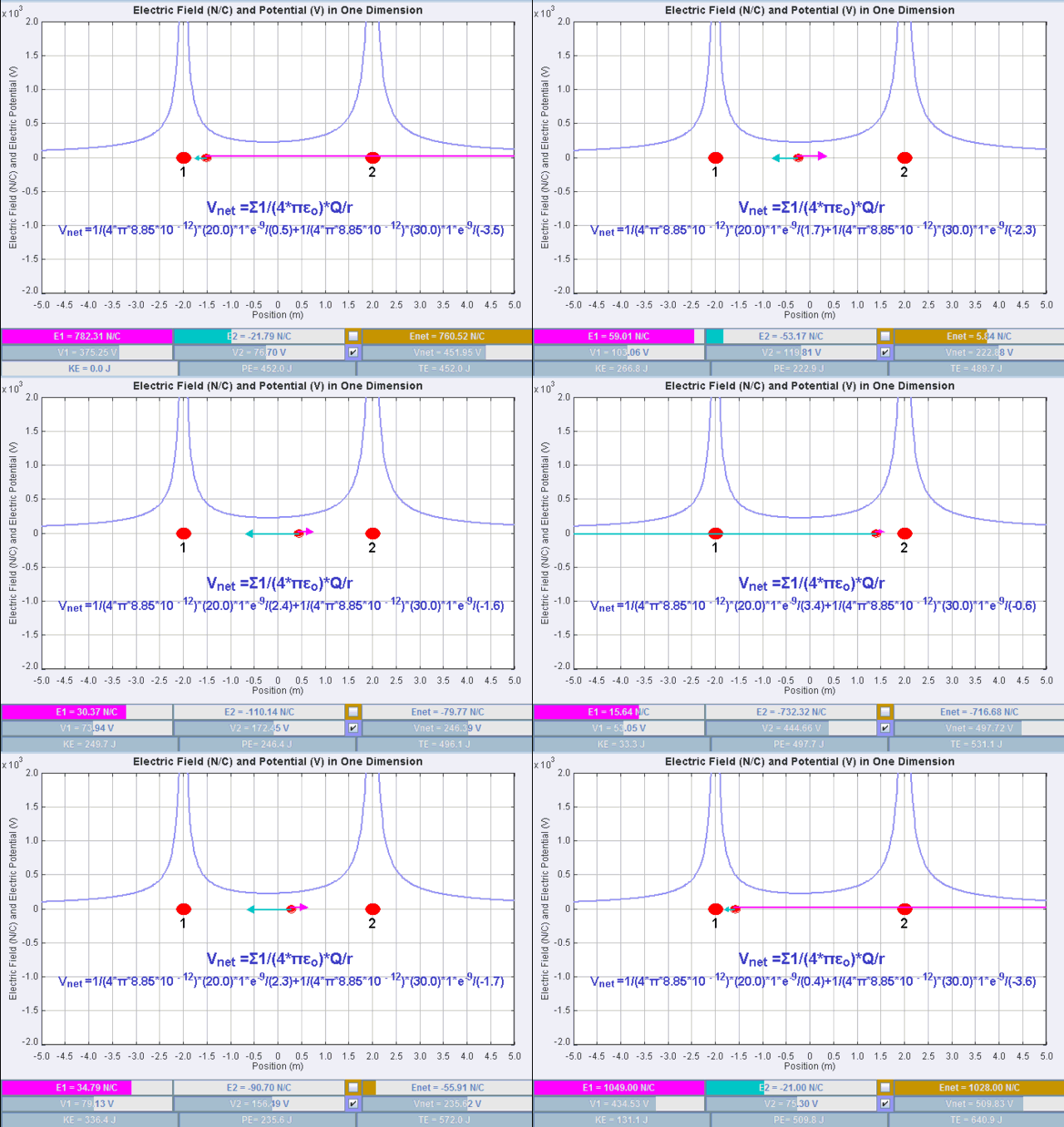
The electrostatic potential energy stored in a system of N point charges is calculated using the electrostatic potential due to all other charges at each charge's location. For a system of one point charge, the electrostatic potential energy is zero, as there are no other sources of electrostatic force. For two point charges, the energy is (1/(4πε₀)) (qQ₁/r₁). For three point charges, the energy is the sum of pairwise interactions: (1/(4πε₀)) [Q₁Q₂/r₁₂ + Q₁Q₃/r₁₃ + Q₂Q₃/r₂₃]. This energy should not be confused with the potential energy of one charge due to the others, which omits the interaction energy among the other charges. The concept is fundamental to understanding electrostatic interactions and energy storage in charge systems.
Did You Know?
- The SI unit of electric potential energy is the joule, named after English physicist James Prescott Joule.
- In the CGS system, the erg is the unit of energy, equal to 10⁻⁷ joules.
- The electrostatic potential energy of a system containing only one point charge is zero.
The Physics of Electric Potential
Electric potential represents the amount of work required to relocate a charged particle from one point to another within an electric field. This quantity, conventionally expressed in volts, sits at the heart of how we quantify the energy landscape that charged matter inhabits. Whenever a positive or negative charge exists, it generates an electric field around itself, and it is within this field that the concept of potential becomes meaningful. In most practical situations, the force experienced by a charged particle is governed by Coulomb's law, which relates the strength of that force to the magnitudes of the charges and the distance separating them. Electric potential energy is not an isolated idea; it is deeply intertwined with magnetism. The motion of charge carriers constitutes an electric current, which in turn gives rise to a magnetic field. Together, these electric and magnetic phenomena form the broader framework of electromagnetism, mathematically unified in Maxwell's equations. Understanding potential energy in this context is essential for grasping how energy is stored, transferred, and ultimately converted into the work that powers the devices we rely on every day.
Ancient Encounters with Electrical Phenomena
Long before the word 'electricity' existed in any language, human civilizations had already encountered its effects in startling ways. Egyptian records from roughly 2750 BCE described electric fish as the 'protectors' of all other fish in their waters. Millennia later, Greek, Roman, and Arab naturalists documented the same creatures, and writers like Pliny the Elder and Scribonius Largus noted the numbing sensation delivered by electric catfish and rays. Remarkably, these ancient physicians even prescribed touching electric fish as a remedy for ailments such as gout and headache, and they observed that the shock could travel along conducting objects. In a separate thread of discovery, people around the Mediterranean noticed that rubbing amber with animal fur caused it to attract small, light objects like feathers. Thales of Miletus, working around 600 BCE, systematized these observations and attributed the attraction to a magnetic quality induced by friction. Although his explanation was wrong, the underlying link between electricity and magnetism would eventually be confirmed by later science.
From Curiosity to Science
For most of human history, electrical phenomena remained a minor intellectual curiosity. That changed in 1600 when William Gilbert published De Magnete, in which he carefully separated the lodestone effect from the static attraction produced by rubbing amber. Gilbert also coined the Neo-Latin term electricus, drawn from the Greek word for amber, and this etymology gave rise to the English words 'electric' and 'electricity,' which appeared in print as early as 1646. Isaac Newton's reflections in Opticks arguably planted the seeds of the field-theory approach to electric forces. Through the 17th and 18th centuries, researchers including Otto von Guericke, Robert Boyle, Stephen Gray, and C. F. du Fay expanded experimental knowledge. Benjamin Franklin's work in the 1750s proved transformative: his famous kite experiment demonstrated that lightning was electrical, and his explanation of the Leyden jar introduced the idea of positive and negative charges. By 1791, Luigi Galvani had shown that neurons use electrical signals to command muscles, and in 1800 Alessandro Volta's pile of alternating zinc and copper layers gave scientists a dependable source of electrical energy for the first time.
The Engine of Modern Civilization
The late nineteenth century transformed electricity from a laboratory subject into the backbone of industrial and domestic life. The theoretical groundwork had been laid by Hans Christian Ørsted and André-Marie Ampère in 1819–1820, who recognized the unity of electric and magnetic phenomena. Michael Faraday's 1821 invention of the electric motor and Georg Ohm's 1827 mathematical analysis of circuits followed, while James Clerk Maxwell's 1861–1862 work definitively linked electricity, magnetism, and light into a single framework. The engineering revolution that followed was extraordinary: figures such as Thomas Edison, Nikola Tesla, George Westinghouse, Werner von Siemens, and many others turned electrical science into practical infrastructure. This rapid expansion powered the Second Industrial Revolution, reshaping manufacturing, transport, heating and cooling, lighting, communications, and computation. In electronics, active components like vacuum tubes, transistors, diodes, and integrated circuits, together with their passive interconnections, built the circuits that underpin every modern device. Electricity's versatility made it the foundation upon which modern industrial society rests.
Gallery
Frequently Asked Questions
Who is Electric potential energy?
Electric potential energy is a form of stored energy, measured in joules, that exists because of how a set of point charges is arranged within a defined system. It arises from the conservative Coulomb forces acting between those charges, so it depends on their relative positions rather than their motion.
What are Electric potential energy's powers/role?
Its role is to store energy based on the configuration of charged objects, whether an object carries it due to its own charge or its position relative to other charged bodies. It is distinguished from electrostatic potential energy, which applies specifically when the electric field in the system is time-invariant.
How does Electric potential energy's story end?
In practice, this stored energy is typically converted into kinetic energy or other forms when charges are released and move under the influence of the Coulomb force. Because the underlying force is conservative, the total energy is conserved—the potential energy simply transforms rather than vanishing.
Why is Electric potential energy important?
It provides the energy-based framework for understanding how charged particles interact, bridging force descriptions and work-energy descriptions of electromagnetism. Without it, we could not properly account for the work done by electric fields in both static and time-varying scenarios.
What's Electric potential energy's naming origin?
Its SI unit, the joule, is named after James Prescott Joule, the physicist who established the mechanical equivalent of heat. In the CGS system the corresponding unit is the erg, equal to 10⁻⁷ joules.
More in Electricity And Magnetism 1-24
Elsewhere in the Electricity And Magnetism universe
Spotted an error? Know more?
This is a living reference — every entry is fact-audited, and reader corrections feed straight into our audit queue. Suggest an edit · See this site's audit record