
Electric displacement field
Auxiliary vector field in Maxwell's equations combining electric field and polarization.

Modified by user:Guy vandegrift · CC0
The electric displacement field (denoted by D), also called electric flux density, is a vector field that appears in Maxwell's equations. It accounts for the electromagnetic effects of polarization and that of an electric field, combining the two in an auxiliary field. It plays a major role in the physics of phenomena such as the capacitance of a material, the response of dielectrics to an electric field, how shapes can change due to electric fields in piezoelectricity or flexoelectricity, as well as the creation of voltages and charge transfer due to elastic strains.
- field
- Physics
- known_for
- Auxiliary field in Maxwell's equations combining electric field and polarization
- symbol
- D
- also_called
- Electric flux density
- related_equation
- D ≡ ε₀E + P
Lore & Background
The electric displacement field is defined as D ≡ ε₀E + P, where ε₀ is the vacuum permittivity, E is the electric field, and P is the polarization density. It satisfies Gauss's law in a dielectric: ∇·D = ρ_f, where ρ_f is the free charge density. The flux lines of D must begin and end on free charges. D is not determined exclusively by free charge; in electrostatic situations, ∇×D = ∇×P, meaning inherent polarization can give rise to an electric field even without free charge, as in a bar electret. Note that while many non-centrosymmetric materials can exhibit piezoelectricity, not all do, and they do not necessarily possess a permanent polarization.
Reader's Guide
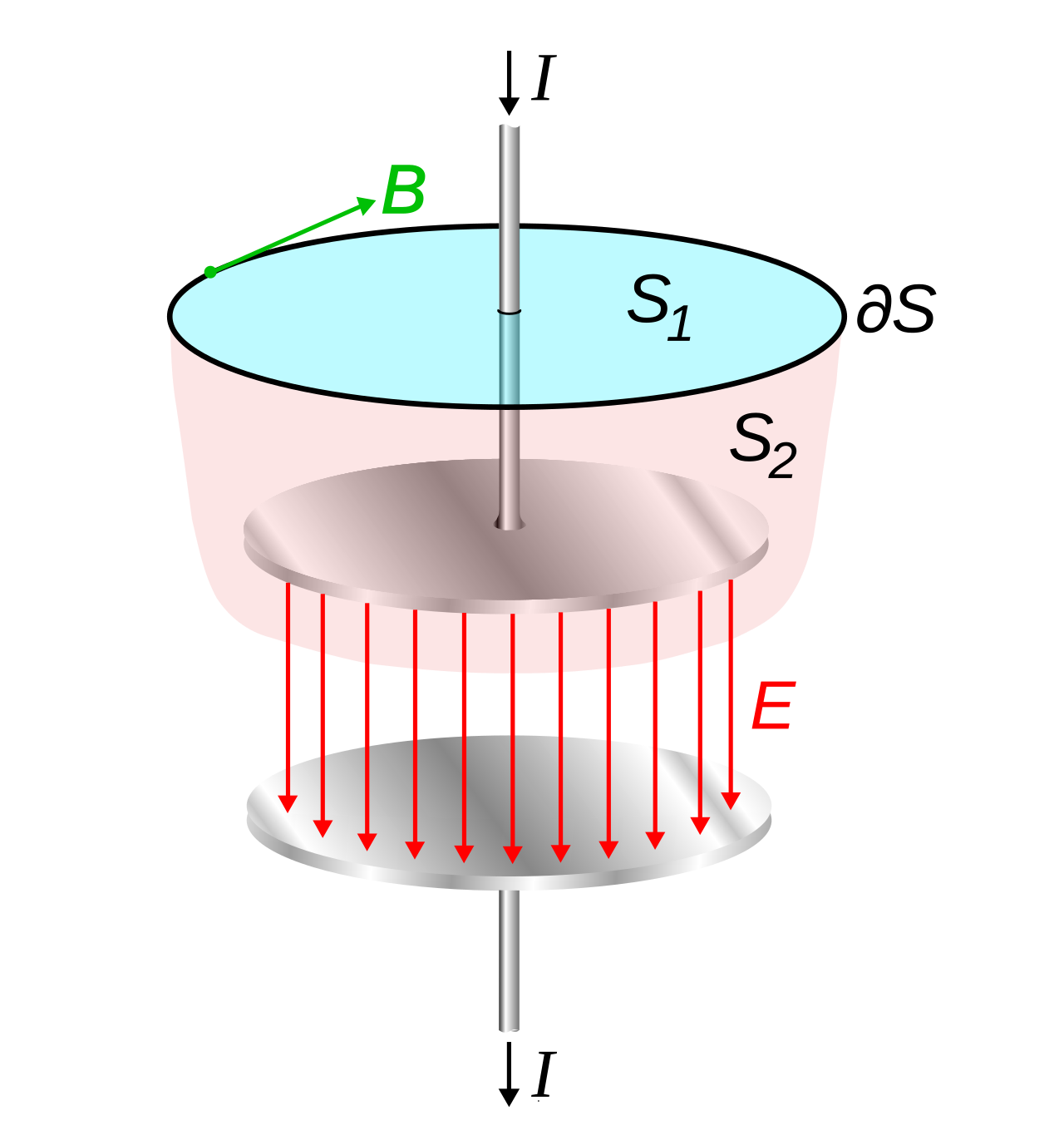
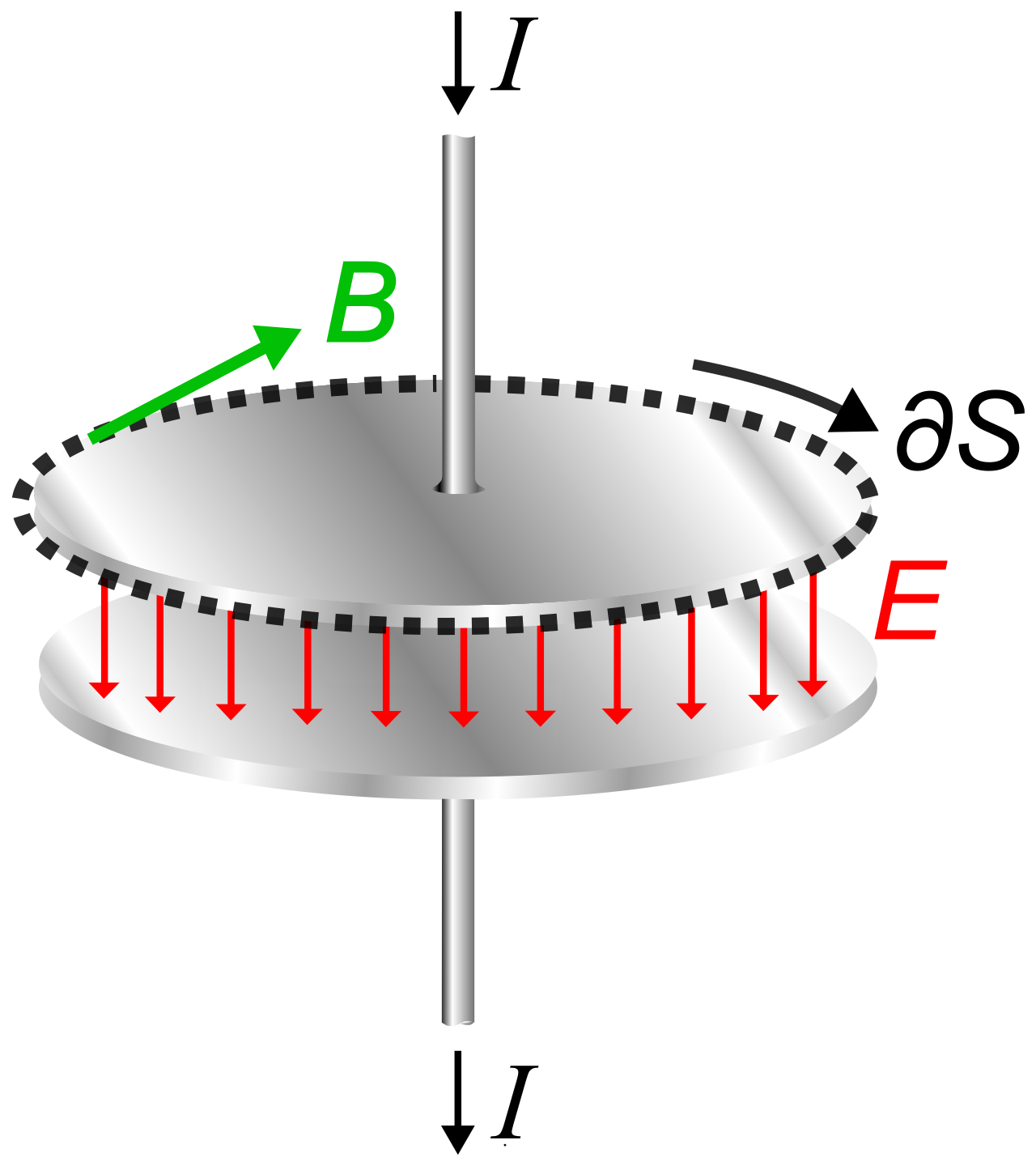
The electric displacement field is significant because it simplifies Maxwell's equations in materials by incorporating polarization effects into an auxiliary field. Its rate of change, ∂D/∂t, is the displacement current density, essential for electromagnetic wave propagation. In linear, homogeneous, isotropic dielectrics, D = εE, where ε is the permittivity. However, in anisotropic, nonlinear, or time-dependent media, the relationship becomes more complex, involving tensors or frequency-dependent permittivity. The field's boundary condition, (D₁ - D₂)·n̂ = σ_f, relates the discontinuity in D to free surface charge. The concept is fundamental to understanding capacitance, dielectric response, piezoelectricity, flexoelectricity, and the magnetoelectric effect. The Kramers–Kronig relations constrain the frequency dependence of permittivity due to causality.
Did You Know?
- The rate of change of D, ∂D/∂t, is the displacement current density.
- In a material with an inversion center, the symmetry means that in the absence of an applied field, there is no net dipole; however, an applied electric field can still induce dipoles.
- Materials without an inversion center may display piezoelectricity, but not all do, and they do not always have a permanent polarization.
- D is not determined exclusively by free charge; inherent polarization can give rise to an electric field, as in a bar electret.
The Field Born from Charge
At the most fundamental level, any accumulation of positive or negative electric charge gives rise to an electric field in the surrounding space. This field is the primary agent through which charged particles experience force, a relationship quantified in most practical situations by Coulomb's law. The electric potential, expressed in volts, captures the work needed to shift a charge from one location to another within this field, providing a scalar measure of the field's influence. When charges begin to move, they form an electric current, and this motion simultaneously gives birth to a magnetic field, demonstrating that electric and magnetic phenomena are two facets of a single underlying reality. These interconnected concepts—charge, field, force, potential, and current—form the theoretical bedrock from which more sophisticated field descriptions, including the displacement field, are ultimately derived. The displacement field refines the basic charge-to-field relationship, extending the framework to account for how fields are described when the simple vacuum picture is no longer sufficient.
The Electromagnetic Unity
Electricity and magnetism are not separate phenomena but rather two expressions of a single unified force known as electromagnetism, a relationship codified in Maxwell's equations. The motion of charge carriers constitutes an electric current, and this current invariably produces a magnetic field, while the presence of static charge generates an electric field. The recognition that these two aspects belong together was a landmark achievement: Hans Christian Ørsted and André-Marie Ampère established the unity of electric and magnetic phenomena in 1819–1820, and James Clerk Maxwell later definitively linked electricity, magnetism, and light in his 1861–1862 work on physical lines of force. The displacement field, as a component of this unified electromagnetic description, inherits its significance from the broader framework that treats electric and magnetic effects as inseparable aspects of one physical reality governed by a single set of equations. Without this unification, the displacement field would lack the theoretical context that gives it meaning and predictive power.
A Millennia-Long Path to Understanding
Humanity's grasp of electric phenomena unfolded over thousands of years. Ancient Egyptian texts from 2750 BCE already noted the shocking power of electric fish, and Greek, Roman, and Arab naturalists later documented the numbing effects of electric catfish and rays. Around 600 BCE, Thales of Miletus observed that rubbing amber with fur attracted light objects, though he mistakenly attributed the effect to magnetism. The field remained largely an intellectual curiosity until William Gilbert's 1600 treatise De Magnete, in which he carefully distinguished the lodestone effect from static electricity and coined the term electricus, from the Greek word for amber. Isaac Newton's early investigations in Opticks arguably planted the seeds of field theory. Benjamin Franklin's 1752 kite experiment confirmed lightning's electrical nature, and his explanation of the Leyden jar introduced the dual positive-negative charge model. By the 19th century, Faraday's motor, Ohm's circuit analysis, and Maxwell's equations transformed scattered observations into a coherent theoretical structure from which the displacement field emerges.
From Laboratory Curiosity to Industrial Engine
The late 19th century witnessed electricity's transformation from a subject of scientific inquiry into the backbone of industrial civilization. Pioneers including Thomas Edison, Nikola Tesla, George Westinghouse, Werner von Siemens, and Alexander Graham Bell turned theoretical understanding into practical engineering, driving the Second Industrial Revolution. Electricity's versatility reshaped transport, heating and cooling, lighting, communications, and computation, embedding itself into the infrastructure of modern society. In electric power systems, current energises equipment on a massive scale, while in electronics, circuits built around active components such as transistors, diodes, vacuum tubes, and integrated circuits—along with their passive interconnections—enable the information age. The displacement field, as part of the theoretical apparatus that describes how electric fields are characterised within these systems, underpins the design and analysis of the very technologies that made electricity the foundation of modern industrial life. Its role is inseparable from the broader electromagnetic framework that engineers rely upon daily.
Gallery




More in Electricity And Magnetism 1-24
Elsewhere in the Electricity And Magnetism universe
Spotted an error? Know more?
This is a living reference — every entry is fact-audited, and reader corrections feed straight into our audit queue. Suggest an edit · See this site's audit record