
Electric susceptibility
Dimensionless constant measuring dielectric polarization response.

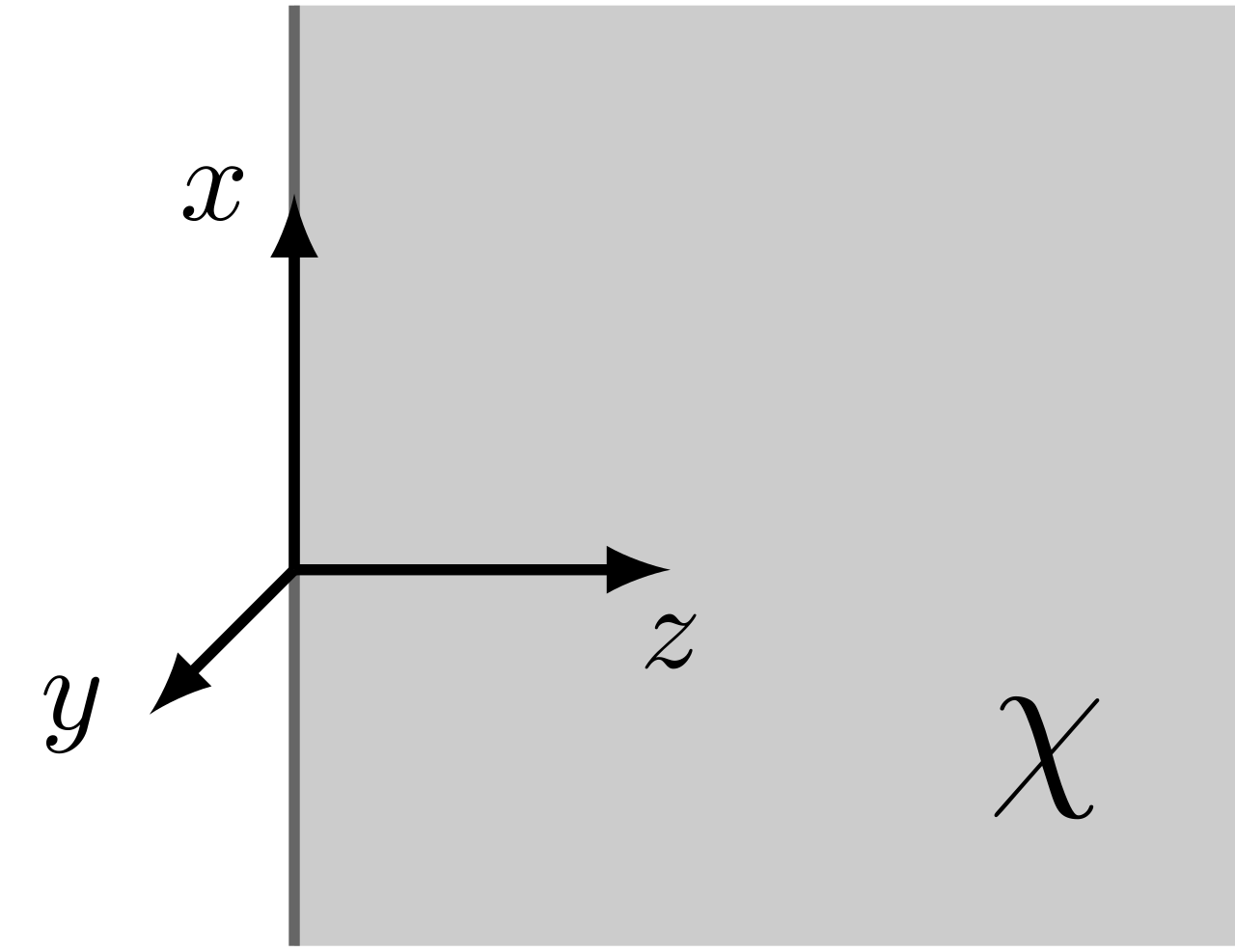
Original: Phillipsphysics ( talk · contribs ) Vector: Leonel Sohns ( talk · cont · CC BY-SA 4.0
Electric susceptibility (χₑ; from Latin 'susceptibilis' meaning 'receptive') is a dimensionless proportionality constant that quantifies the degree of polarization of a dielectric material in response to an applied electric field. It is a fundamental parameter in electromagnetism, influencing the electric permittivity of materials and thereby affecting phenomena such as capacitance and the speed of light within a medium.
- field
- Electricity (electromagnetism)
- symbol
- χₑ
- dimension
- Dimensionless
- related_quantity
- Relative permittivity (εᵣ)
- key_relation
- χₑ = εᵣ − 1
Lore & Background
Electric susceptibility is defined for linear dielectrics as the constant of proportionality (which may be a tensor) relating an electric field E to the induced dielectric polarization density P, such that P = ε₀ χₑ E, where ε₀ is the electric permittivity of free space. In materials where susceptibility is anisotropic, it is represented as a tensor known as the susceptibility tensor; many linear dielectrics are isotropic, but a material can be both linear and anisotropic, or non-linear but isotropic.
Reader's Guide
Electric susceptibility is a key parameter in electromagnetism, directly linking the polarization of a dielectric material to an applied electric field. Its significance lies in its relationship to relative permittivity (εᵣ = 1 + χₑ), which determines how a material affects electric fields, capacitance, and the speed of light. The concept extends to molecular polarizability (α), where the induced dipole moment p of a molecule relates to the local electric field via p = ε₀ α E_local. However, the local field often differs from the macroscopic field, requiring relations such as the Clausius–Mossotti equation (χₑ/(3+χₑ) = Nα/3) to connect microscopic and macroscopic properties. Ambiguity exists in the definition of molecular polarizability: some definitions include ε₀ in α (giving α units of volume), while others omit it (giving α units of C·m²/V). This parameter is essential for understanding dielectric behavior in capacitors, optical materials, and other electromagnetic applications.
Did You Know?
- Electric susceptibility is dimensionless and defined as χₑ = εᵣ − 1, with χₑ = 0 for a vacuum.
- In anisotropic materials, electric susceptibility is represented as a tensor.
- The Clausius–Mossotti relation connects macroscopic susceptibility to molecular polarizability: χₑ/(3+χₑ) = Nα/3.
- There is ambiguity in the definition of molecular polarizability; some definitions give it units of volume (m³), others units of C·m²/V.
Physical Role and Broader Influence
Electric susceptibility, denoted χₑ and derived from the Latin word "susceptibilis" meaning "receptive," serves as a dimensionless proportionality constant that quantifies how readily a dielectric material polarizes when subjected to an external electric field. A higher value signals a material's stronger capacity to align its internal charges, which in turn diminishes the net electric field within the medium and enables energy storage. This single parameter cascades into a wide range of electromagnetic phenomena. Because susceptibility directly shapes the electric permittivity of a substance, it governs everything from the capacitance values achieved in practical capacitors to the propagation speed of light through that medium. In essence, χₑ acts as a foundational link between a material's internal charge response and the macroscopic electrical behavior engineers and physicists observe in real-world devices and optical systems.
The Linear Dielectric Framework
For materials classified as linear dielectrics, electric susceptibility takes on a precise mathematical role: it is the constant of proportionality connecting the applied electric field E to the resulting polarization density P. The governing equation reads P = ε₀χₑE, where ε₀ represents the permittivity of free space in farads per meter, P carries units of coulombs per square meter, and E is measured in volts per meter. Notably, χₑ itself is dimensionless, making it a pure ratio that characterizes the material's response independent of unit systems. A particularly elegant relationship ties susceptibility to the relative permittivity, also called the dielectric constant: χₑ equals εᵣ minus one. This means a vacuum, where no polarization can occur, has a susceptibility of exactly zero. Furthermore, the electric displacement field D incorporates both the free-space contribution and the polarization contribution, yielding D = ε₀(1 + χₑ)E, which simplifies to D = εE where ε is the absolute permittivity of the material.
Anisotropy and Tensor Behavior
While many common linear dielectrics behave identically in every direction, a substantial class of materials, particularly crystalline solids, exhibit susceptibility that varies with the orientation of the applied field. In such anisotropic cases, the simple scalar χₑ is replaced by a full susceptibility tensor, a multidimensional mathematical object that encodes how polarization responds differently along different crystallographic axes. This tensor formulation is essential for accurately modeling the dielectric behavior of many naturally occurring and engineered crystals. Importantly, linearity and isotropy are independent properties: a material can be linear yet anisotropic, as seen in numerous crystalline structures, or it can be non-linear while remaining isotropic. The distinction matters because it determines whether a single number suffices to describe the material's response or whether a matrix of coefficients is required. For practical applications involving direction-dependent capacitance or birefringent optical effects, the tensor description is not merely a mathematical convenience but a physical necessity.
Bridging the Microscopic and Macroscopic
At the molecular level, a closely related parameter called molecular polarizability α links the induced dipole moment p of a single molecule to the local electric field acting upon it, expressed as p = ε₀αE_local. When this microscopic response is summed over N molecules per unit volume, the total polarization density becomes P = Nε₀αE_local. This connection reveals a subtle but critical complication: the local field experienced by any individual molecule can differ significantly from the bulk applied field due to the collective influence of neighboring dipoles. Consequently, the macroscopic susceptibility χₑ is not simply Nα; rather, the relationship χₑE = NαE_local shows that the local-field correction is embedded within the effective susceptibility. This bridge between the single-molecule picture and the continuum description is what allows physicists to predict bulk dielectric properties from molecular-scale parameters, provided the local-field problem is properly accounted for.
Gallery
Frequently Asked Questions
Who is Electric susceptibility?
Electric susceptibility (χₑ) is a dimensionless constant in electromagnetism that measures how strongly a dielectric material becomes polarized when an external electric field is applied. Its name derives from the Latin word 'susceptibilis,' meaning 'receptive.'
What are Electric susceptibility's powers or role?
It quantifies the degree of polarization a material exhibits under an applied electric field, essentially telling you how 'receptive' the material is to electrical influence. It directly shapes the permittivity of the material and thereby governs effects like capacitance and the reduced speed of light inside that medium.
How does Electric susceptibility's story end?
As a fundamental parameter, it doesn't have a narrative arc so much as a permanent place in the equations of electromagnetism. Its legacy lives on in every calculation of dielectric behavior, from capacitor design to optical propagation in materials.
Why is Electric susceptibility important to the broader field?
It serves as the bridge between a material's microscopic polarization response and its macroscopic electrical properties. Without it, we couldn't properly describe how materials alter electric fields, store charge, or slow down electromagnetic waves.
What is Electric susceptibility's relationship with Relative permittivity?
The two are linked by the simple relation χₑ = εᵣ − 1, meaning susceptibility is essentially the permittivity's excess over the vacuum baseline. This makes χₑ the natural quantity for describing how much a material deviates from free-space behavior.
More in Electricity And Magnetism 1-24
Elsewhere in the Electricity And Magnetism universe
Spotted an error? Know more?
This is a living reference — every entry is fact-audited, and reader corrections feed straight into our audit queue. Suggest an edit · See this site's audit record