
Electrical resistivity and conductivity
Resistivity measures opposition to current; conductivity is its reciprocal.

Wolff, F.A.; Dellinger, J.H. · No restrictions
Electrical resistivity (also called volume resistivity or specific electrical resistance) is a fundamental specific property of a material that measures its electrical resistance or how strongly it resists electric current. A low resistivity indicates a material that readily allows electric current. Resistivity is commonly represented by the Greek letter ρ (rho). The SI unit of electrical resistivity is the ohm-metre (Ω⋅m). Electrical conductivity (or specific conductance) is the reciprocal of electrical resistivity. It represents a material's ability to conduct electric current. It is commonly signified by the Greek letter σ (sigma), but κ (kappa) and γ (gamma) are sometimes used. The SI unit of electrical conductivity is siemens per metre (S/m).
- symbol_resistivity
- ρ (rho)
- si_unit_resistivity
- ohm-metre (Ω⋅m)
- symbol_conductivity
- σ (sigma), also κ (kappa) or γ (gamma)
- si_unit_conductivity
- siemens per metre (S/m)
- relationship
- conductivity is the reciprocal of resistivity
- intensive_property
- resistivity and conductivity are intensive properties
Lore & Background
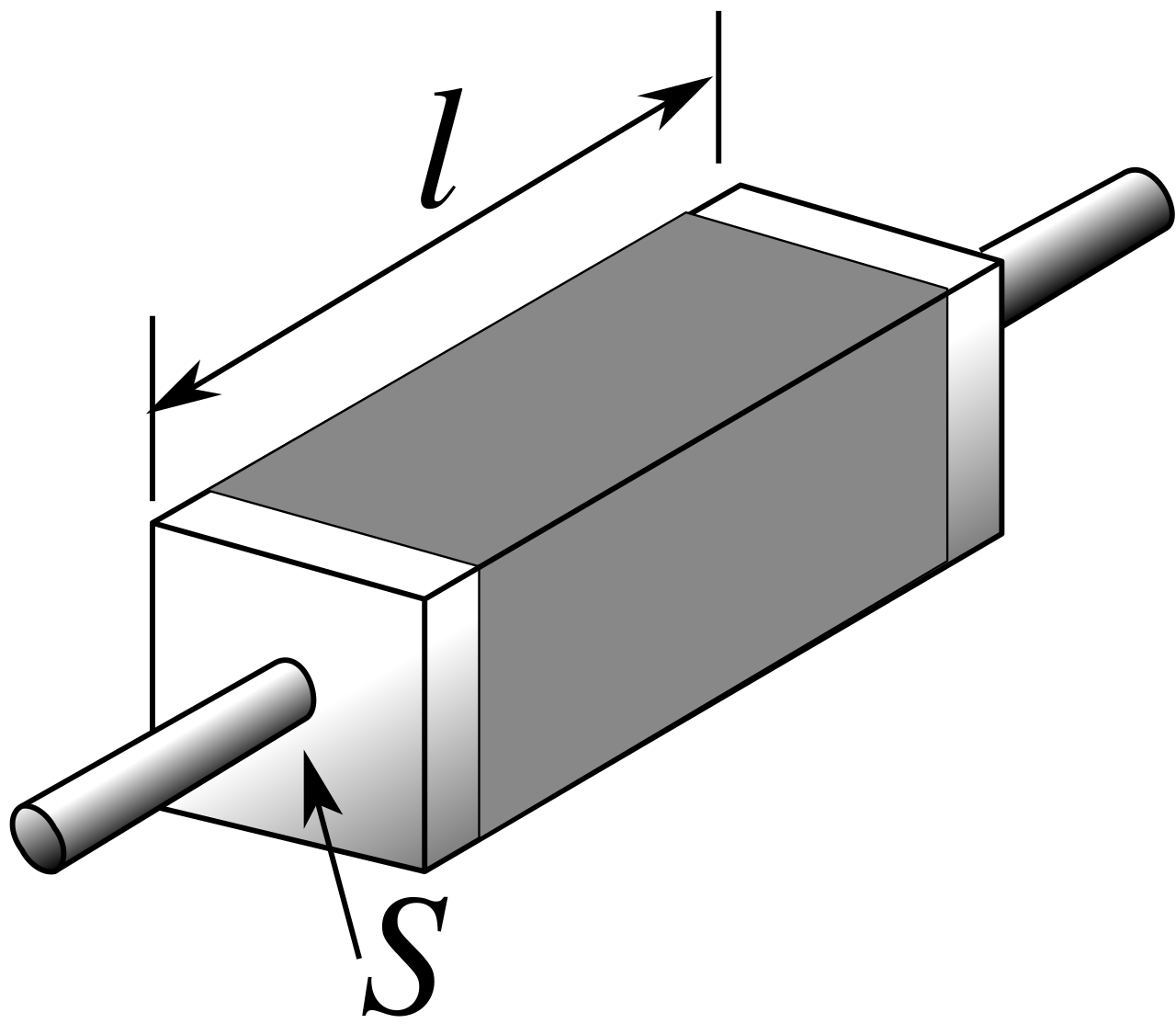
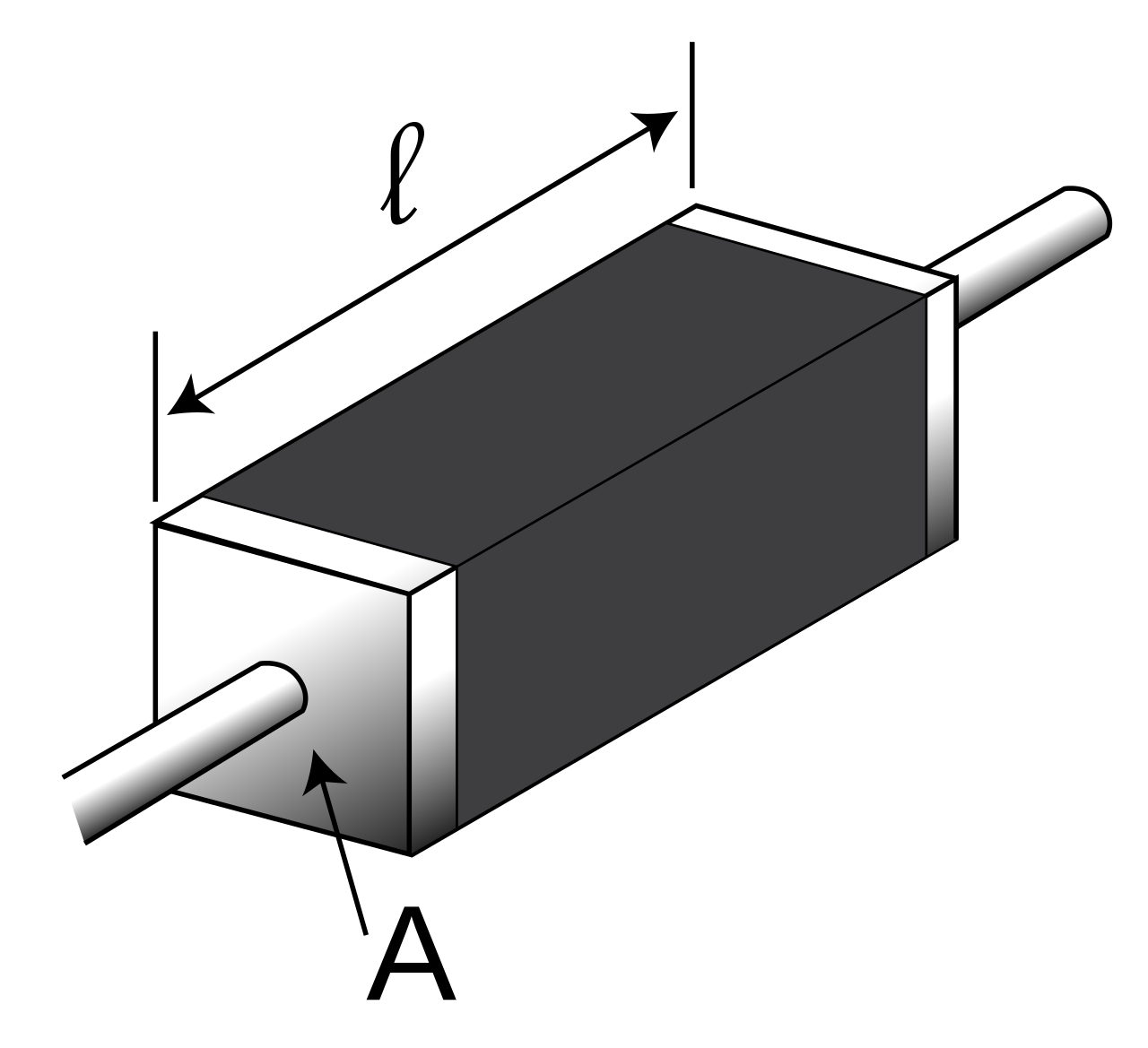
In an ideal case, cross-section and physical composition of the examined material are uniform across the sample, and the electric field and current density are both parallel and constant everywhere. Many resistors and conductors do in fact have a uniform cross section with a uniform flow of electric current, and are made of a single material, so that this is a good model. When this is the case, the resistance of the conductor is directly proportional to its length and inversely proportional to its cross-sectional area, where the electrical resistivity ρ is the constant of proportionality. This is written as R = ρ ℓ / A, and conversely ρ = R A / ℓ.
Reader's Guide
Electrical resistivity and conductivity are fundamental properties that describe how a material interacts with electric current. Resistivity quantifies how strongly a material resists current flow, while conductivity measures its ability to conduct current. These are intensive properties, meaning they are inherent to the material and do not depend on its shape or size. For example, all pure copper wires have the same resistivity, but a long, thin wire has greater resistance than a short, thick one. The relationship between resistance R, resistivity ρ, length ℓ, and cross-sectional area A is given by Pouillet's law: R = ρ ℓ / A. In a hydraulic analogy, high-resistivity materials are like pipes filled with sand, while low-resistivity materials are like empty pipes. For non-uniform materials or complex geometries, resistivity is defined locally as the ratio of electric field to current density. In anisotropic materials, a tensor form of Ohm's law is required. Conductivity is also expressed in terms of charge carrier concentrations and mobilities: σ = q (n μ_n + p μ_p).
Did You Know?
- The SI unit of electrical resistivity is the ohm-metre (Ω⋅m).
- If a 1 m³ solid cube of material has a resistance of 1 Ω between opposite faces, its resistivity is 1 Ω⋅m.
- Conductivity is the reciprocal of resistivity, with SI unit siemens per metre (S/m).
- Rubber has a far larger resistivity than copper.
Resistivity as an Intrinsic Fingerprint of Matter
Resistivity, also called volume resistivity or specific electrical resistance, serves as a fundamental material fingerprint that quantifies how strongly a substance opposes the flow of electric current. A low value signals a material that readily admits current, while a high value indicates strong opposition. Crucially, resistivity is an intensive property belonging to the material itself, unlike electrical resistance, which is an extensive property tied to the particular geometry of an object. This distinction means that every piece of pure copper, whether fashioned into a long, thin wire or a thick, short bar, carries the same resistivity value, provided its crystalline structure has not been distorted. A long, thin copper wire will exhibit far greater resistance than a thick, short one, yet the underlying resistivity remains identical. Rubber, by contrast, possesses a resistivity far larger than copper's. This intrinsic character makes resistivity a powerful tool for identifying and comparing materials independent of their shape or size, and it is universally denoted by the Greek letter rho (ρ).
The Geometry of Current Flow and Pouillet's Law
In the idealized scenario where a conductor has a uniform cross-section, a single homogeneous composition, and both the electric field and current density remain parallel and constant throughout, a clean mathematical relationship emerges. The resistance of such a conductor scales directly with its length and inversely with its cross-sectional area, with resistivity acting as the constant of proportionality. This relationship, known as Pouillet's law after Claude Pouillet, is expressed as R equals rho times length divided by area. A particularly elegant consequence arises when one imagines a one-metre cube of material with perfectly conductive contacts on two opposite faces: the measured resistance in ohms is numerically identical to the material's resistivity expressed in ohm-metres. A helpful hydraulic analogy illuminates the concept—pushing current through a high-resistivity material resembles forcing water through a pipe packed with sand, while a low-resistivity material behaves like an empty pipe. In both cases, the pipe's length and diameter still modulate the total resistance, just as geometry shapes electrical resistance.
Conductivity and the Microscopic Charge-Carrier Picture
Electrical conductivity, sometimes called specific conductance, is defined as the exact reciprocal of resistivity, capturing a material's capacity to carry electric current. While sigma (σ) is the most common symbol, electrical engineers frequently employ kappa (κ), and gamma (γ) also appears in certain contexts. The SI unit for conductivity is the siemens per metre. Beyond this simple reciprocal relationship, conductivity reveals a deeper microscopic structure. It is directly proportional to the sum of electron concentration multiplied by electron mobility and hole concentration multiplied by hole mobility, all scaled by the elementary electron charge. In formula form, sigma equals q times (n times mu-n plus p times mu-p). This expression makes clear that a material's ability to conduct current depends not merely on how many charge carriers are available but also on how freely those carriers can move through the lattice. Both electrons and holes contribute to the total conduction, and their respective mobilities determine how effectively each type of carrier participates.
Units, Symbols, and the Intensive-versus-Extensive Distinction
The language of resistivity and conductivity rests on a carefully chosen set of symbols and units that have become standard across physics and engineering. Resistivity is represented by the Greek letter rho and measured in ohm-metres, a unit that can be parsed as ohms multiplied by square metres of cross-sectional area and then divided by metres of length. Conductivity, its reciprocal, carries the unit siemens per metre. Both quantities are classified as intensive properties, meaning they describe the opposition of a standard, unit-sized cube of material to current flow. In contrast, electrical resistance and conductance are extensive properties that describe the opposition of a specific, finite object. This distinction is crucial: resistance changes if you stretch a wire or widen it, but resistivity does not. The one-metre-cube thought experiment—placing sheet contacts on two opposite faces and measuring a resistance of one ohm—provides a concrete, reproducible definition that anchors the unit of resistivity to a tangible physical configuration.
Gallery

Frequently Asked Questions
Who is Electrical resistivity and conductivity?
It isn't a single character but a matched pair of intrinsic material properties: resistivity (ρ) quantifies how hard a substance pushes back against electric current, while conductivity (σ) measures how freely that current is allowed to flow. Together they form the foundational 'identity' of any material in the electricity-and-magnetism canon.
What are Electrical resistivity and conductivity's powers/role?
As intensive properties, their values stay the same regardless of a sample's size or shape, making them reliable fingerprints for every substance. Resistivity is expressed in ohm-metres (Ω⋅m) and conductivity in siemens per metre (S/m), so engineers can pick the right wire, semiconductor, or insulator without re-deriving geometry each time.
How does Electrical resistivity and conductivity's story end?
There is no final chapter because they are permanent, defining traits of matter — the concept simply persists for as long as materials exist. Their numerical values shift with temperature, but the underlying relationship never retires from the physics narrative.
Why is Electrical resistivity and conductivity important?
They let you predict a material's opposition to current purely from its composition, independent of the object's dimensions. Since conductivity is exactly the reciprocal of resistivity, knowing one instantly yields the other, which is why both appear side by side in every circuit-design reference.
What symbols do fans use for resistivity and conductivity?
Resistivity is universally tagged with the Greek letter ρ (rho), while conductivity most commonly wears σ (sigma), though older or specialized texts may show κ (kappa) or γ (gamma). These shorthand symbols keep the fan-encyclopedia consistent across all 24 chapters.
More in Electricity And Magnetism 1-24
Elsewhere in the Electricity And Magnetism universe
Spotted an error? Know more?
This is a living reference — every entry is fact-audited, and reader corrections feed straight into our audit queue. Suggest an edit · See this site's audit record