
Electric flux
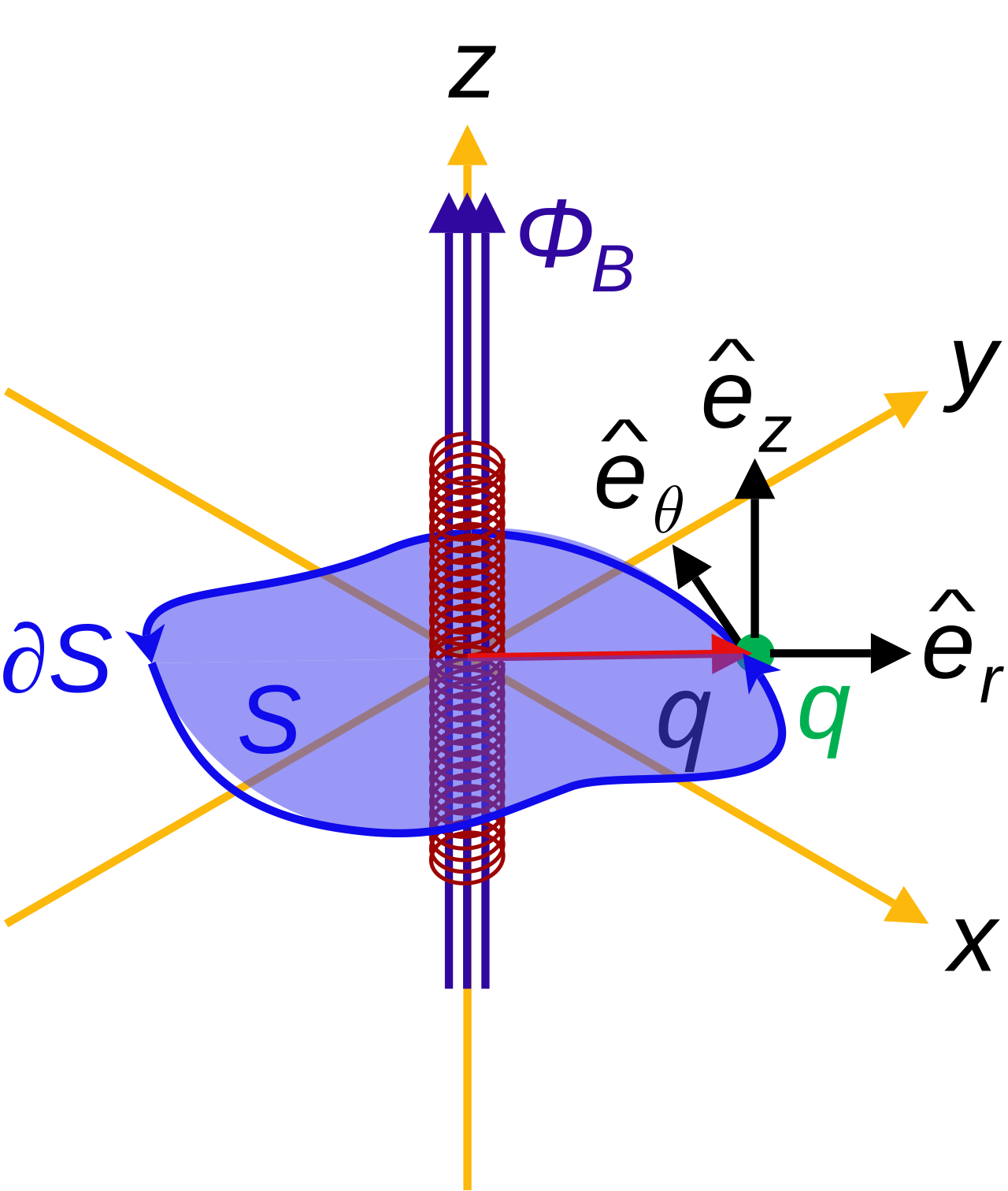
Electric flux measures the electric field crossing a surface.

Maschen · CC0
Electric flux is a concept in electromagnetism representing the total electric field that crosses a given surface. It is directly proportional to the total charge contained within a closed surface, a relationship formalized as Gauss's law, one of Maxwell's equations.
- field
- Electromagnetism
- SI unit
- volt-meter (V·m) or newton-meter squared per coulomb (N·m²·C⁻¹)
- SI base units
- kg·m³·s⁻³·A⁻¹
- dimensional formula
- L³MT⁻³I⁻¹
- related law
- Gauss's law for electric fields
Lore & Background
Electric flux is defined as the surface integral of the electric field over a given area. For a uniform electric field, the flux through a surface of vector area A is given by Φ_E = E · A = EA cos θ, where θ is the angle between the field lines and the normal to the surface. For non-uniform fields, the flux is expressed as dΦ_E = E · dA, integrated over the surface.
Reader's Guide
Electric flux is a fundamental quantity in electromagnetism, central to Gauss's law, which states that the electric flux through a closed surface is proportional to the enclosed charge. This law holds for all situations but is most useful for calculations with high symmetry, such as spherical or cylindrical symmetry. The concept helps visualize electric fields through 'lines of flux' (Gauss lines), whose density corresponds to field strength. Electric flux is unaffected by charges outside the closed surface, though the net electric field may be influenced by them. Its SI unit is the volt-meter, and it is a key component of Maxwell's equations.
Did You Know?
- Electric flux is directly proportional to the total number of electric field lines going through a surface.
- The SI unit of electric flux is the volt-meter (V·m).
- Gauss's law for electric fields relates electric flux through a closed surface to the enclosed charge.
- Electric flux is not affected by charges that lie outside the closed surface.
The Second Strongest Force in Nature
The electromagnetic force ranks as the second most powerful among the four fundamental interactions that govern the universe, and unlike the strong nuclear force, it operates across unlimited distances. At sufficiently high energies, it merges with the weak force into a single unified interaction known as the electroweak interaction, revealing a deeper symmetry in nature. In everyday matter, this force is the dominant player: the electrostatic attraction between positively charged atomic nuclei and negatively charged electrons is what keeps atoms intact, and the same force drives atoms to bond into molecules. When we push or pull a solid object, what we actually feel is the electromagnetic repulsion between the electron clouds of our hand and the object's surface. At the molecular level, the density and structure of matter emerge from a delicate balance: the electromagnetic force pulling charged particles together, counteracted by the momentum that electrons must carry as the Pauli exclusion principle confines them into ever-smaller regions. Every chemical reaction, every phase transition, every material property traces back to this single interaction.
Six Quantities, Three Descriptive Frameworks
The mathematical language of electromagnetism rests on six core quantities organized into three distinct descriptive frameworks. In the simplest setting, where all charges are known directly as in a vacuum, the electric field E and the magnetic flux density B capture the full influence of charges at any point in space and time. When charges reside inside a material that responds to applied fields, physicists introduce the electric displacement field D and the magnetic field strength H to account for how the medium polarizes and magnetizes. A third, more abstract representation trades force for potential energy and momentum, expressing the field through the electric potential V and the magnetic vector potential A. These fields are not independent: a changing electric field spawns a changing magnetic field, which in turn regenerates the electric disturbance, producing a self-propagating oscillation that travels through space as an electromagnetic wave. The force experienced by a charged particle moving through these fields is captured by the Lorentz expression, which combines the electric contribution with a velocity-dependent magnetic term, linking the particle's speed and direction to the force it feels.
From Lightning to Photons
Humanity's encounter with electromagnetism stretches back to antiquity, when observers noted the crackle of lightning, the static cling of rubbed materials, and the curious pull between magnetized iron ore and a compass needle. For centuries these remained separate curiosities. It was not until the eighteenth and nineteenth centuries that scientists forged the mathematical bridges connecting charges, currents, and the phenomena they produce, and crucially demonstrated that electricity and magnetism are two faces of one interaction. This unification revealed that a self-sustaining wave of coupled electric and magnetic oscillations could propagate freely, encompassing everything from gamma rays and x-rays through ultraviolet, visible light, and infrared to microwaves and radio. In the modern era the theory has been pushed further still. The demand that electromagnetic observations remain consistent across different moving reference frames, together with the realization that the speed of light is fixed by the permeability and permittivity of the propagation medium, directly inspired Einstein's special relativity in 1905. Quantum electrodynamics went a step beyond, recasting field changes as discrete excitations known as photons, the quanta of light, thereby weaving electromagnetism into the quantum fabric of matter.
The Engine of Modern Civilization
Beyond the laboratory, electromagnetism is the invisible architecture of nearly every technology that defines contemporary life. The generation, conversion, and distribution of electrical energy all rest on electromagnetic principles. The same principles govern how we produce and detect light, heat, and sound; how fiber-optic cables and wireless networks carry information across continents; how sensors translate physical signals into readable data; how computers process information at electronic speeds; and how electrolysis and electroplating reshape materials at the atomic level. Mechanical motors and actuators that drive everything from industrial machinery to household appliances are, at their core, electromagnetic devices. Even in the realm of chemistry, magnetic interactions between the spin and angular momentum of electrons influence reactivity in ways studied under the heading of spin chemistry. The electromagnetic force, which holds atoms together and binds them into molecules, thus underwrites not only the structure of matter itself but the entire technological infrastructure that allows humans to manipulate that matter on demand.
Gallery




Frequently Asked Questions
Who is Electric flux?
Electric flux is the concept introduced in Chapter 1-24 of the Electricity and Magnetism series that quantifies how much electric field passes through a specified surface. Think of it as the 'throughput' measure for field lines crossing a boundary.
What are Electric flux's powers/role?
Its core ability is to tally the net electric field crossing a surface, and for a closed surface it scales directly with the total charge trapped inside. That proportional link is exactly what Gauss's law—one of Maxwell's equations—formalizes.
How does Electric flux's story end?
Electric flux doesn't get a standalone finale; it serves as the bridge that leads straight into Gauss's law, where its proportional relationship to enclosed charge becomes the headline result. From there it feeds into the broader Maxwell-equations arc of the series.
Why is Electric flux important?
It gives physicists a surface-integral tool that turns a messy field calculation into a simple charge-counting problem whenever the geometry is symmetric. Without it, Gauss's law—and a huge chunk of practical electrostatics—wouldn't have a clean mathematical statement.
What is Electric flux's SI unit?
The standard unit is the volt-meter (V·m), equivalent to newton-meter squared per coulomb (N·m²·C⁻¹). In base SI terms that works out to kg·m³·s⁻³·A⁻¹.
More in Electricity And Magnetism 1-24
Elsewhere in the Electricity And Magnetism universe
Spotted an error? Know more?
This is a living reference — every entry is fact-audited, and reader corrections feed straight into our audit queue. Suggest an edit · See this site's audit record