Electric power
Electric power is the rate of electrical energy transfer.

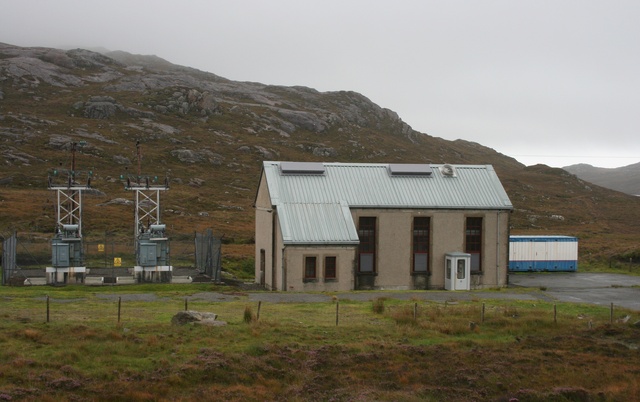
Alan O'Dowd · CC BY-SA 2.0
Electric power is the rate of transfer of electrical energy within a circuit. Its SI unit is the watt, defined as one joule per second. In common parlance, electric power refers to the production and delivery of electrical energy, an essential public utility in much of the world.
- SI unit
- watt
- Symbol
- P
- Common prefixes
- kilowatt, megawatt, gigawatt
- Basic formula
- P = V × I
- Related quantities
- real power, reactive power, apparent power
Lore & Background
Electric power is defined as the rate of doing work, measured in watts, and represented by the letter P. The term wattage is used colloquially to mean electric power in watts. The electric power produced by an electric current I consisting of a charge of Q coulombs every t seconds passing through a voltage difference V is given by P = W/t = V × I. The voltage between two terminals is defined as the work required to move a unit charge from one terminal to the other against the force of the electric field.
Reader's Guide
Electric power is transformed to other forms of energy when electric charges move through an electric potential difference. Components in an electric circuit can be divided into active devices (power sources) and passive devices (loads). In resistive circuits, power is dissipated according to P = I²R = V²/R. In alternating current circuits, real power is given by P = Vrms × Irms × cosθ, where θ is the phase angle between voltage and current. The relationship among real, reactive, and apparent power can be expressed using the power triangle. Electric power is usually produced by electric generators or batteries and supplied to businesses and homes by the electric power industry through an electrical grid. It can be delivered over long distances by transmission lines and used for applications such as motion, light, or heat with high efficiency.
Did You Know?
- The SI unit of electric power is the watt, defined as one joule per second.
- Electric power can be supplied by electric generators or by sources such as electric batteries.
- In alternating current circuits, real power is calculated using the root-mean-square voltage and current multiplied by the cosine of the phase angle.
- The passive sign convention defines power flowing out of a circuit into a component as positive.
The Physics Underpinning Everything
Electricity, at its core, describes the behavior of matter that carries an electric charge—whether that charge is positive or negative. When such charged particles sit still, they generate an electric field around them; when they move, they create an electric current that simultaneously produces a magnetic field. This inseparable pairing of electric and magnetic effects is what Maxwell's equations formalize under the broader umbrella of electromagnetism. In practical terms, Coulomb's law governs the force one charged particle exerts on another, while electric potential—measured in volts—quantifies the work required to shift a charge from one point in a field to another. These principles manifest in everyday phenomena: the crackle of lightning, the cling of static on a sweater, the glow of an electric heater, and the sharp snap of a discharge. Understanding these fundamentals is what allows engineers to design everything from a simple circuit to a continental power grid.
Ancient Curiosity and the Amber Connection
Long before anyone could name the force, human beings encountered it. Egyptian papyri from roughly 2750 BCE already referenced electric fish as guardians of other aquatic creatures, and centuries later Greek, Roman, and Arab physicians noted that catfish and rays could deliver numbing jolts—shocks that could even travel along conducting materials. Some patients with gout or headaches were literally told to touch an electric fish, hoping the violent zap would ease their suffering. Around 600 BCE, Thales of Miletus observed that rubbing amber with cat's fur made it attract feathers and other light debris. He mistook the effect for magnetism, but the observation planted a seed. For over a thousand years, electricity remained essentially a parlor trick and a philosophical footnote, with no systematic theory to explain what was happening.
From Franklin's Kite to Maxwell's Equations
The slow thaw from curiosity to science accelerated dramatically in the 17th and 18th centuries. William Gilbert's 1600 treatise De Magnete separated the lodestone's pull from the static produced by rubbed amber, and he coined the term electricus—derived from the Greek word for amber—giving us the English words 'electric' and 'electricity.' Benjamin Franklin, who sold his personal possessions to fund his experiments, famously flew a kite in a stormy sky in 1752, watching sparks leap from a metal key to his knuckles and thereby proving lightning was electrical. He also unraveled the Leyden jar's mysterious charge storage by proposing positive and negative charges. The 19th century then stacked breakthrough upon breakthrough: Galvani showed neurons fired electrical signals, Volta built the first reliable battery, Ørsted and Ampère revealed the unity of electricity and magnetism, Faraday invented the motor, Ohm formalized circuit mathematics, and Maxwell wove it all into a single theoretical framework.
The Engine of the Modern World
By the late 1800s, electricity leapt from laboratory curiosity to the backbone of civilization. A constellation of inventors and engineers—Edison, Tesla, Westinghouse, Siemens, Swan, Bell, and many others—transformed the science into practical systems for lighting homes, powering factories, and connecting cities. This surge in electrical technology was the engine behind the Second Industrial Revolution, reshaping how people worked, traveled, and communicated. Today, electricity underpins virtually every facet of industrial society: it drives transport networks, heats and cools buildings, illuminates streets, carries data across communication lines, and powers the computation that runs modern life. In electronics, the same principles govern circuits built around active components like transistors, diodes, vacuum tubes, and integrated circuits, alongside the passive interconnection technologies that tie them together. The versatility of electric current—its ability to be generated, transmitted, stored, and converted—makes it the single most foundational utility of the modern era.
Gallery




Frequently Asked Questions
Who is Electric power?
Electric power is the rate at which electrical energy moves through a circuit, essentially measuring how fast charge carriers deliver energy to a load. It is represented by the symbol P and quantified in watts, where one watt equals one joule of energy transferred each second.
What are Electric power's powers or role?
Its core function is to quantify how much electrical energy a device consumes or a source delivers per unit time, calculated by multiplying voltage by current (P = V × I). In broader usage it also encompasses the generation, transmission, and distribution of that energy to homes and industries.
How does Electric power's story end?
In any closed circuit the electrical energy is ultimately converted into other forms—heat in resistors, light in lamps, mechanical work in motors—so the power is fully dissipated by the load. There is no further 'afterlife'; the energy simply leaves the electrical domain and becomes thermal, radiant, or kinetic energy in the surroundings.
Why is Electric power important?
It is the backbone of modern civilization because it lets society move energy from large centralized plants to individual appliances with high efficiency and on demand. Without the ability to generate, transmit, and consume electrical power at scale, virtually every industrial, medical, and domestic system would collapse.
What are Electric power's common units and related quantities?
Beyond the base watt, engineers routinely work in kilowatts, megawatts, and gigawatts to match the scale of household, plant, and grid-level systems. In AC circuits the concept splits into real power (actual work done), reactive power (energy sloshing back and forth in fields), and apparent power (the product of RMS voltage and current).
More in Electricity And Magnetism 1-24
Elsewhere in the Electricity And Magnetism universe
Spotted an error? Know more?
This is a living reference — every entry is fact-audited, and reader corrections feed straight into our audit queue. Suggest an edit · See this site's audit record