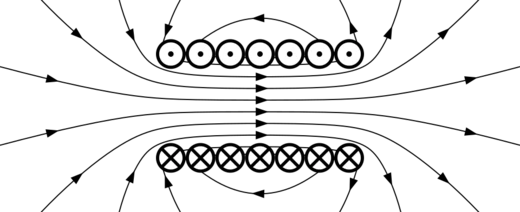
Electric-field screening
Screening damps electric fields via mobile charge carriers.

United States. Office of Strategic Services · Public domain
Electric-field screening is the damping of electric fields caused by the presence of mobile charge carriers. It is an important part of the behavior of charge-carrying mediums, such as ionized gases (classical plasmas), electrolytes, and electronic conductors (semiconductors, metals). In a fluid composed of electrically charged constituent particles, the Coulomb force between particles complicates theoretical treatment, but screening reduces the effective interaction to a short-range 'screened' Coulomb interaction.
- field
- Physics
- known_for
- Damping of electric fields by mobile charge carriers; Debye screening; Thomas–Fermi approximation
- related_concepts
- Debye–Hückel approximation, Thomas–Fermi approximation, jellium model, screened Coulomb interaction
Lore & Background
In physics, screening is the damping of electric fields caused by the presence of mobile charge carriers. It is an important part of the behavior of charge-carrying mediums, such as ionized gases (classical plasmas), electrolytes, and electronic conductors (semiconductors, metals). In a fluid, with a given permittivity ε, composed of electrically charged constituent particles, each pair of particles interacts through the Coulomb force. This interaction complicates the theoretical treatment of the fluid; for example, a naive quantum mechanical calculation of the ground-state energy density yields infinity, which is unreasonable. The difficulty lies in the fact that even though the Coulomb force diminishes with distance as 1/r², the average number of particles at each distance r is proportional to r², assuming the fluid is fairly isotropic. As a result, a charge fluctuation at any one point has non-negligible effects at large distances.
Reader's Guide
In reality, these long-range effects are suppressed by the flow of particles in response to electric fields. This flow reduces the effective interaction between particles to a short-range 'screened' Coulomb interaction. This system corresponds to the simplest example of a renormalized interaction. In solid-state physics, especially for metals and semiconductors, the screening effect describes the electrostatic field and Coulomb potential of an ion inside the solid. Like the electric field of the nucleus is reduced inside an atom or ion due to the shielding effect, the electric fields of ions in conducting solids are further reduced by the cloud of conduction electrons. The screened potential determines the inter atomic force and the phonon dispersion relation in metals. The screened potential is used to calculate the electronic band structure of a large variety of materials, often in combination with pseudopotential models. The screening effect leads to the independent electron approximation, which explains the predictive power of introductory models of solids like the Drude model, the free electron model and the nearly free electron model.
Did You Know?
- The first theoretical treatment of electrostatic screening was due to Peter Debye and Erich Hückel, dealing with a stationary point charge embedded in a fluid.
- In plasma physics, electric-field screening is also called Debye screening or shielding, and manifests on macroscopic scales by a Debye sheath next to a material with which the plasma is in contact.
- The Thomas–Fermi approximation is valid at low temperatures, such as for electrons in metals.
- In a one-component plasma, each electron repels others, creating a positively charged 'screening hole' that cancels the electron's field at large distances.
Discovery and the First Experimental Proof
In 1933, German physicists Walther Meissner and Robert Ochsenfeld made a landmark observation that would redefine our understanding of superconductivity. Working with samples of tin and lead, they applied an external magnetic field and then cooled the materials below their critical transition temperatures. What they found was striking: the interior magnetic field was nearly entirely cancelled. Because a superconductor conserves magnetic flux, they could only detect this expulsion indirectly—the field that vanished from inside reappeared as an enhanced field outside the sample. Their measurements of the external field distribution around the samples revealed this remarkable behavior. This experiment was pivotal because it demonstrated, for the first time, that superconductors possessed a property far beyond mere zero electrical resistance. The active expulsion of magnetic flux established a uniquely defining characteristic of the superconducting state, one that no ordinary conductor, however perfect, could replicate.
The London Equation and Surface Screening
Two years after the discovery, brothers Fritz and Heinz London provided a phenomenological framework that captured the essence of the effect. Their key insight was that the electromagnetic free energy of a superconductor reaches its minimum when the magnetic field satisfies a specific differential relationship: the Laplacian of the field equals the field divided by the square of a characteristic length, now called the London penetration depth. This equation predicts that any magnetic field present at the surface decays exponentially as one moves into the interior. Within that thin surface layer, the field is not fully cancelled; beyond it, the interior field approaches zero. The mechanism behind this shielding is the induction of lossless, persistent currents in the surface region. These currents generate an opposing field that precisely counteracts the applied field in the bulk. The resulting volume magnetic susceptibility equals negative one, signifying perfect diamagnetism. Crucially, this diamagnetism differs fundamentally from the weak orbital diamagnetism of ordinary materials, since it originates entirely from surface screening currents rather than from electron motion throughout the volume.
Why It Is Not Simply Perfect Conductivity
A common misconception is that the Meissner effect is merely a consequence of infinite electrical conductivity. In reality, the two phenomena are fundamentally distinct. A perfect conductor obeys Faraday's law: any change in magnetic flux through its volume is forbidden, so it simply preserves whatever field configuration it already had. If such a material starts in zero field and a field is turned on, induced currents will screen the interior, mimicking the Meissner effect. But if it starts with a field already penetrating it and the external source is removed, the perfect conductor traps that field forever. A superconductor, by contrast, always expels interior flux regardless of its prior state. This difference becomes most apparent during field cooling, where a sample is cooled into the superconducting phase while an external field is present. The superconductor actively drives the interior field to zero, whereas a perfect conductor would leave it frozen in place. The superconducting magnetic state is therefore history-independent and represents a true thermodynamic equilibrium, while the perfect-conductor state depends entirely on its past.
Theoretical Legacy and Broader Impact
The Meissner effect catalyzed a cascade of theoretical advances in condensed-matter physics. In 1935, the London brothers built their phenomenological theory directly upon the experimental evidence, explaining both resistanceless current flow and magnetic flux expulsion, and enabling the first quantitative predictions about superconducting behavior. Yet their framework remained descriptive; it did not reveal the microscopic origin of the phenomenon. That deeper understanding arrived in 1957 with the BCS theory, from which the penetration depth and the Meissner effect emerge as natural consequences of the underlying electron pairing mechanism. Still, some physicists have argued that BCS theory does not fully account for the Meissner effect, leaving room for ongoing debate. Beyond condensed matter, the Meissner effect has served as a paradigm for the Higgs mechanism in particle physics, illustrating how a field can acquire an effective mass and be expelled from a medium. In this way, a 1933 observation about tin and lead samples continues to shape our understanding of fundamental physics across disciplines.
Gallery



Frequently Asked Questions
Who is Electric-field screening?
Electric-field screening is the process by which mobile charge carriers in a medium rearrange themselves to damp out an externally applied electric field. It is a defining feature of plasmas, electrolytes, and electronic conductors such as metals and semiconductors.
What are Electric-field screening's powers?
Its signature move is converting a long-range Coulomb interaction into a short-range screened one, so that each particle effectively feels only its nearest neighbors. This is the same mechanism captured by Debye screening in ionized gases and by the Thomas–Fermi approximation in electron gases.
How does Electric-field screening's arc resolve?
In every setting it appears in, a characteristic length scale—Debye length in a plasma, Thomas–Fermi length in a metal—marks the distance over which the field is essentially extinguished. Past that range the original field is gone and the medium behaves as though the charges interact only locally.
Why is Electric-field screening important to the canon?
Without it, the pairwise Coulomb force between every charged constituent would make any statistical or quantum treatment of a charge-carrying fluid hopelessly intractable. Screening is what allows physicists to replace that all-to-all interaction with a simple short-range model, underpinning the Debye–Hückel, Thomas–Fermi, and jellium frameworks.
Who are Electric-field screening's key allies?
Its most frequent collaborators are the Debye–Hückel approximation for electrolyte solutions, the Thomas–Fermi approximation for degenerate electron gases, and the jellium model for uniform electron fluids. Together they form the standard toolkit for describing how mobile charges conspire to suppress an applied field.
More in Electricity And Magnetism 1-24
Elsewhere in the Electricity And Magnetism universe
Spotted an error? Know more?
This is a living reference — every entry is fact-audited, and reader corrections feed straight into our audit queue. Suggest an edit · See this site's audit record