
Electric dipole moment
Measure of charge separation in a system.

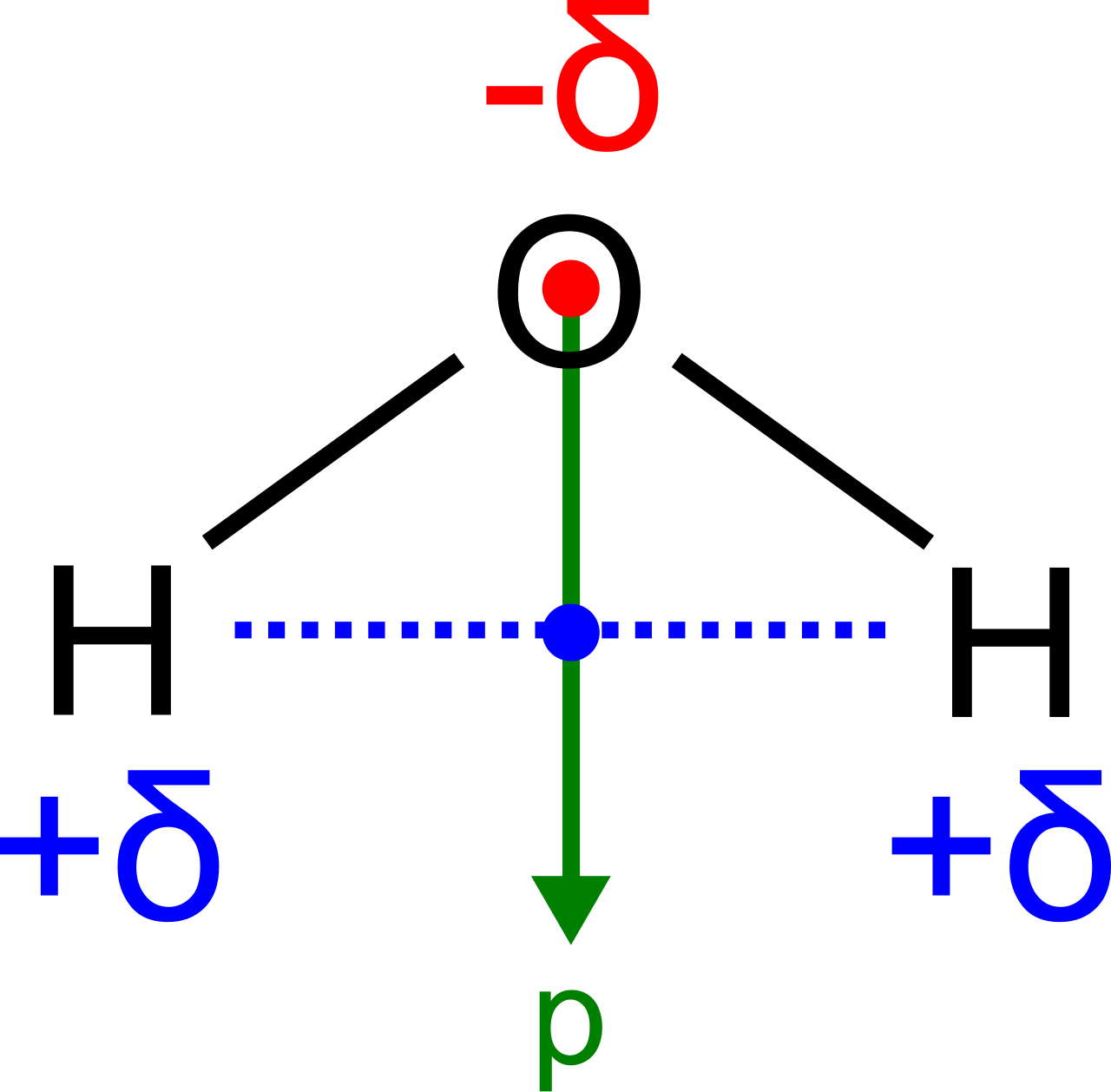
Original: Xzapro4 ( talk · contribs ) Derivative work: Matt ( talk · contribs ) · CC BY-SA 3.0
The electric dipole moment is a measure of the separation of positive and negative electrical charges within a system, indicating the system's overall polarity. It is a fundamental concept in physics and chemistry, used to describe the behavior of charge distributions in electric fields.
- SI unit
- coulomb-metre (C⋅m)
- CGS unit
- debye (D)
- definition
- first-order term of the multipole expansion
- simple case
- two point charges +q and −q separated by distance d
- magnitude formula
- p = qd
- vector formula
- p = qd
- sign convention (physics)
- from negative to positive charge
Lore & Background
The electric dipole moment is defined theoretically by the first-order term of the multipole expansion, consisting of two equal and opposite charges infinitesimally close together. In practice, real dipoles have separated charge. For two point charges, the magnitude is p = qd, directed from the negative to the positive charge. The vector form p = qd uses the displacement vector d pointing from negative to positive charge. This sign convention is used in physics, while chemistry uses the opposite.
Reader's Guide
The electric dipole moment is significant because it quantifies the polarity of a system, influencing interactions with external electric fields. An object with a dipole moment p experiences a torque τ = p × E in a uniform electric field, aligning the dipole with the field to minimize potential energy U = −p·E. In non-uniform fields, a net force can act on the dipole. The dipole moment is also used to define polarization density. For continuous charge distributions, it is expressed as an integral over volume, and for point charges, as a sum of charge-weighted position vectors. This concept is essential in atomic physics, chemistry, and electromagnetism.
Did You Know?
- The SI unit for electric dipole moment is the coulomb-metre (C⋅m).
- The debye (D) is a CGS unit used in atomic physics and chemistry.
- The electric dipole moment vector points from the negative charge to the positive charge in physics.
- A dipole in a uniform electric field experiences torque but no net force.
Fundamental Definition and Measurement
The electric dipole moment quantifies how positive and negative charges are spatially separated within a system, serving as a measure of overall polarity. In the International System of Units, it is expressed in coulomb-metres, while atomic physics and chemistry commonly employ the debye, a CGS-derived unit. Theoretically, the dipole moment represents the first-order term in the multipole expansion of a charge distribution. In its idealized form, it is described as two equal and opposite charges positioned infinitesimally close together, yet real-world dipoles always involve a finite separation between their constituent charges. This distinction between the mathematical ideal and physical reality is important: the point-dipole idealization is a limiting case used for analytical convenience, whereas actual molecular and atomic dipoles possess measurable spatial extent between their charge centers. The dipole moment thus bridges the gap between a simple two-charge model and the complex charge distributions found in matter.
Vector Definition and Sign Conventions
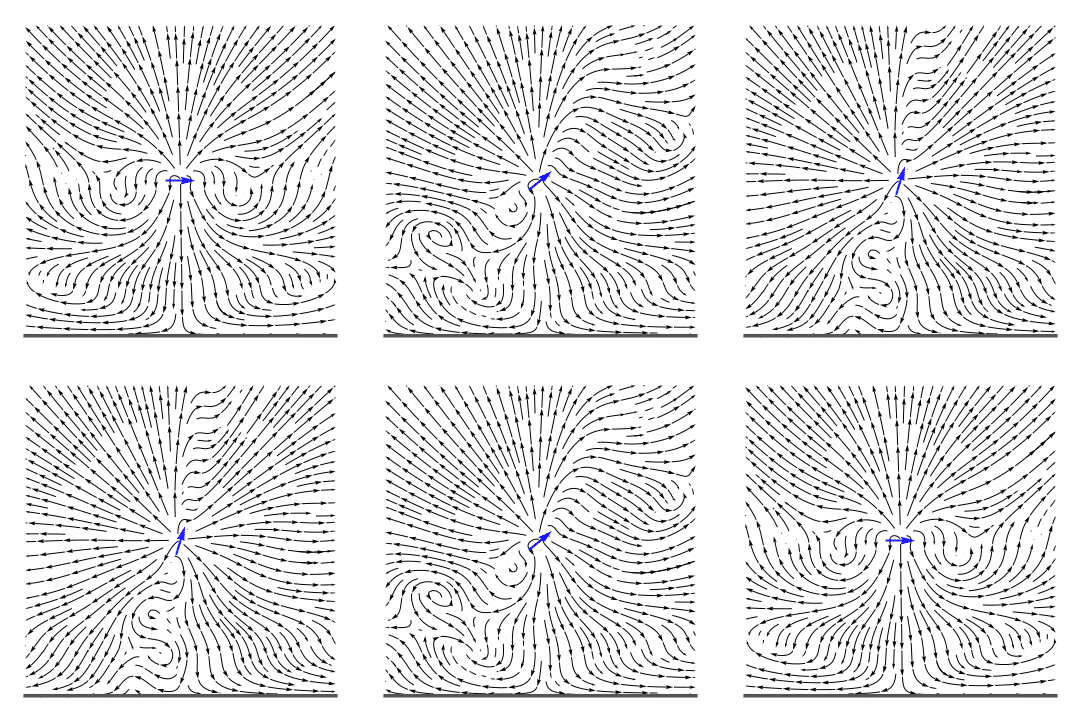
When two point charges of magnitude q, one positive and one negative, are separated by a distance d, the resulting dipole moment has a magnitude of p = qd. Expressed as a vector, p equals q multiplied by the displacement vector d, which points from the negative charge toward the positive one. This directional convention is critical: in physics, the dipole moment vector always points from negative to positive charge, and this orientation is what causes the dipole to align with an external electric field. Notably, chemistry adopts the opposite sign convention, defining the dipole direction from positive to negative. This discrepancy between disciplines can create confusion when comparing literature across fields. The idealized point dipole—two infinite charges with vanishing separation but a finite product p—serves as a foundational construct in the definition of polarization density, linking the microscopic dipole to macroscopic material properties. The flux lines generated by the dipole's own charges point from positive to negative, which in the presence of an external field tend to oppose the external flux lines, a geometric consequence of the chosen sign convention.
Energy, Torque, and Field Interaction
When a dipole with moment p is immersed in an external electric field E, it experiences a torque given by the cross product τ = p × E. This torque acts to rotate the dipole until it aligns parallel with the field, representing the lowest-energy configuration. The potential energy is expressed as U = −p·E, where the negative sign and dot product encode the angular dependence: energy is minimized when the dipole is parallel to the field, maximized when antiparallel, and vanishes when perpendicular. The torque vector is directed normal to the plane defined by p and E, with its sense determined by the right-hand rule. In a spatially uniform field, the dipole may twist and oscillate but experiences no net translational force, since the forces on its two ends cancel. However, in a non-uniform field, the force on one end no longer balances the other, producing a net force that is generally parallel to the dipole moment itself. This distinction between uniform and non-uniform field behavior is essential for understanding how dipoles move through inhomogeneous electric environments.
General Mathematical Formulation
For a continuous charge distribution confined within a volume V, the dipole moment is computed by integrating the product of the local charge density ρ(r′) and the displacement vector (r′ − r) over that volume, where r marks the observation point. This integral formulation generalizes the simple two-charge picture to arbitrary charge configurations. For a discrete array of N point charges, the continuous density is replaced by a sum of Dirac delta functions, each centered at the position ri of charge qi. Substituting this discrete representation into the integral yields a summation over all individual charges, recovering the familiar vector sum. The dipole moment thus occupies a privileged position in the multipole expansion: it is the first non-trivial term that captures the asymmetry of a charge distribution, going beyond the net charge (zeroth-order term) to describe how that charge is spatially arranged. This hierarchical structure—monopole, dipole, quadrupole, and higher terms—provides the systematic framework through which electrostatic interactions of complex systems are decomposed and understood.
Gallery



Frequently Asked Questions
Who is Electric dipole moment?
Electric dipole moment is a vector quantity that quantifies how far apart positive and negative charges sit within a system, giving the whole arrangement a net polarity. It is the first-order term in the multipole expansion, making it the simplest descriptor of any charge distribution's orientation.
What are Electric dipole moment's powers/role?
Its core role is to determine how a charge distribution responds to an external electric field, producing a torque that tries to rotate the dipole into alignment with the field. In its simplest incarnation, two equal and opposite point charges separated by distance d yield a magnitude of p = qd.
How does Electric dipole moment's story end?
In a uniform external field the dipole experiences pure torque with zero net force, so it simply settles into alignment with the field lines. In a non-uniform field it also feels a net force dragging it toward the region of stronger field, which is how real dipoles migrate through matter.
Why is Electric dipole moment important?
It is the foundational descriptor behind molecular polarity, dielectric behaviour, and spectroscopy, bridging physics and chemistry in one concept. Without it we could not explain why water acts as a polar solvent or how a simple antenna radiates electromagnetic waves.
What is Electric dipole moment's signature stat sheet?
Its SI unit is the coulomb-metre (C⋅m), while chemists and spectroscopists often prefer the debye (D) in CGS-style units. The defining vector expression p = qd, with d pointing from the negative charge toward the positive one, is the equation fans memorise first.
More in Electricity And Magnetism 1-24
Elsewhere in the Electricity And Magnetism universe
Spotted an error? Know more?
This is a living reference — every entry is fact-audited, and reader corrections feed straight into our audit queue. Suggest an edit · See this site's audit record