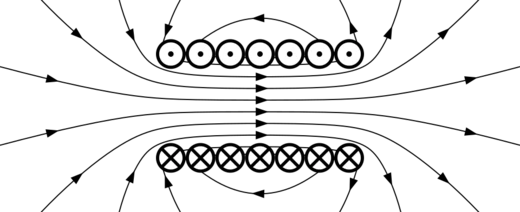
Displacement current density
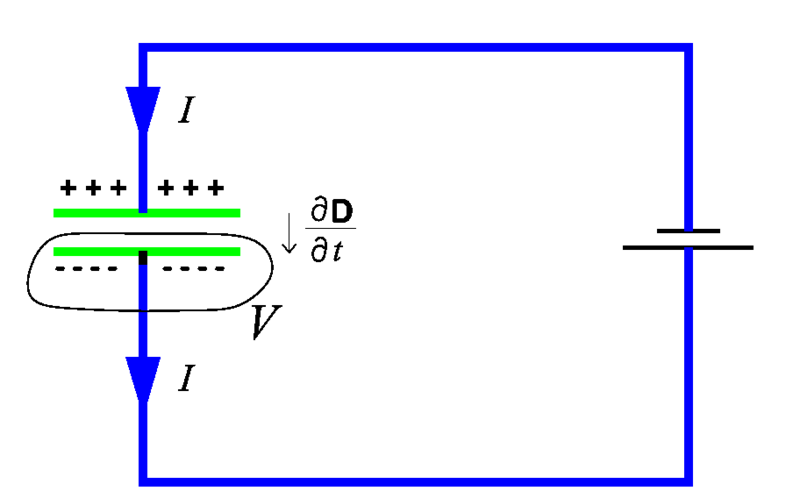
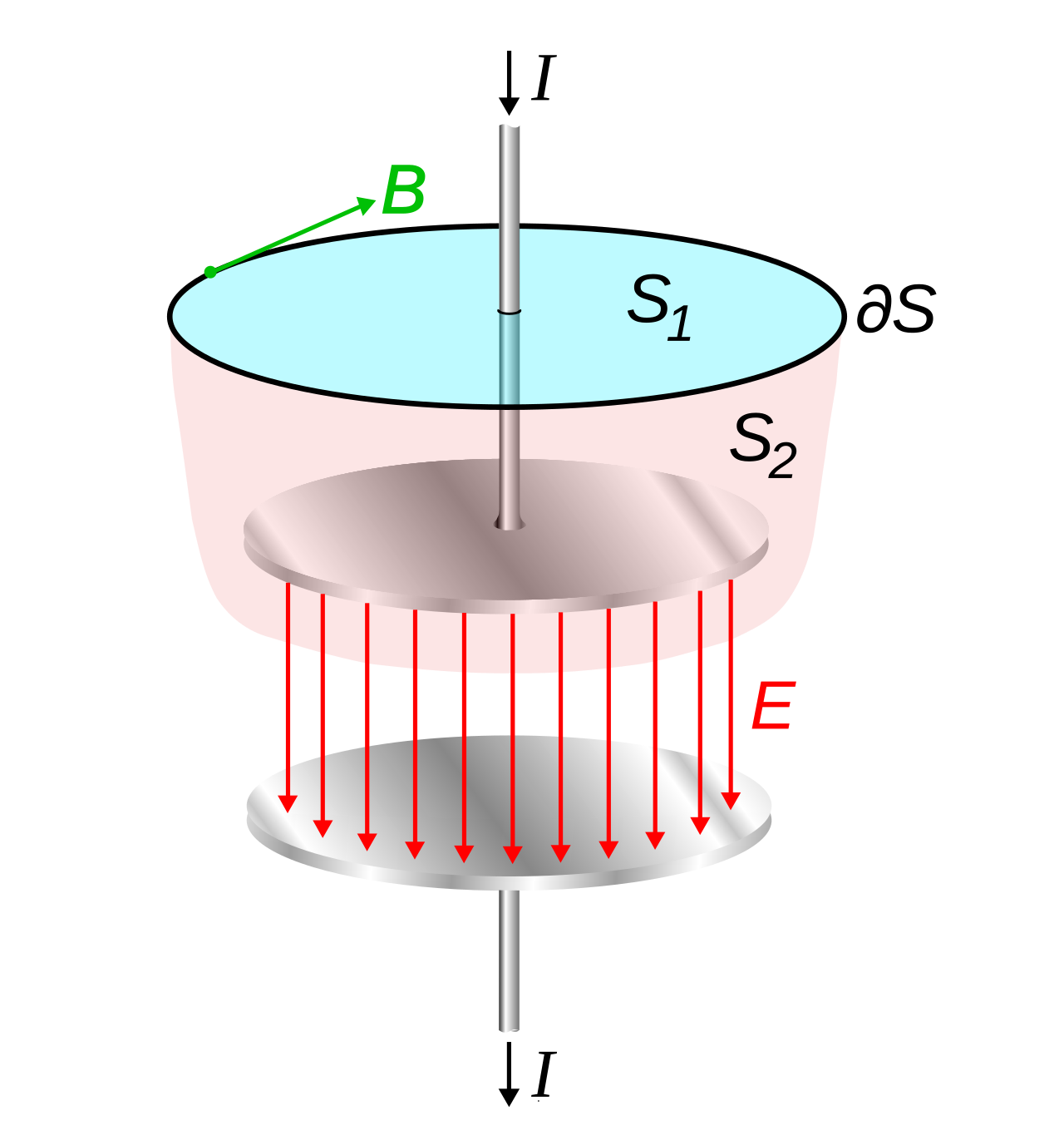
Time-varying electric field acting as a magnetic field source.

Chetvorno · Public domain
Displacement current density is a concept in electromagnetism representing the rate of change of the electric displacement field D, appearing as ∂D/∂t in Maxwell's equations. It has the same units as electric current density and is a source of the magnetic field just as actual current is, but it is not an electric current of moving charges; rather, it is a time-varying electric field. In physical materials, there is also a contribution from the slight motion of charges bound in atoms, called dielectric polarization.
- field
- Electromagnetism
- known_for
- Addition to Ampère's circuital law enabling derivation of the electromagnetic wave equation
Lore & Background
Maxwell added displacement current to the electric current term in Ampère's circuital law.
Reader's Guide
The displacement current term is now seen as a crucial addition that completed Maxwell's equations and is necessary to explain many phenomena, most particularly the existence of electromagnetic waves. This derivation is now generally accepted as a historical landmark in physics by virtue of uniting electricity, magnetism and optics into one single unified theory. The displacement current density has two components in a dielectric: ε₀ ∂E/∂t, present in material media and free space, and ∂P/∂t, called polarization current density, which comes from the change in polarization of individual molecules. Maxwell made no special treatment of the vacuum, treating it as a material medium.
Did You Know?
- Displacement current density has the same units as electric current density.
- It is a source of the magnetic field just as actual current is.
- The polarization current density term comes from the change in polarization of individual molecules of a dielectric material.
- Maxwell used the amended Ampère's circuital law to derive the electromagnetic wave equation.
Maxwell's Conception and the Unification of Physics
In 1861, James Clerk Maxwell published the third part of his paper On Physical Lines of Force, in which he first introduced the notion of displacement current. His motivation was tied to the displacement of electric particles within a dielectric medium. He recognized that Ampère's circuital law, as it stood, was incomplete and needed an additional term alongside the conventional conduction current. By appending this new term, Maxwell created what would become the amended form of Ampère's law. Two years later, in his 1865 treatise A Dynamical Theory of the Electromagnetic Field, he leveraged this corrected law to derive the electromagnetic wave equation. That derivation stands as one of the great landmarks in the history of physics, because it wove together electricity, magnetism, and optics into a single coherent theoretical framework. What began as a physical intuition about particles shifting in a dielectric ultimately became the linchpin that made the entire edifice of classical electromagnetism possible.
A Current Without Moving Charges
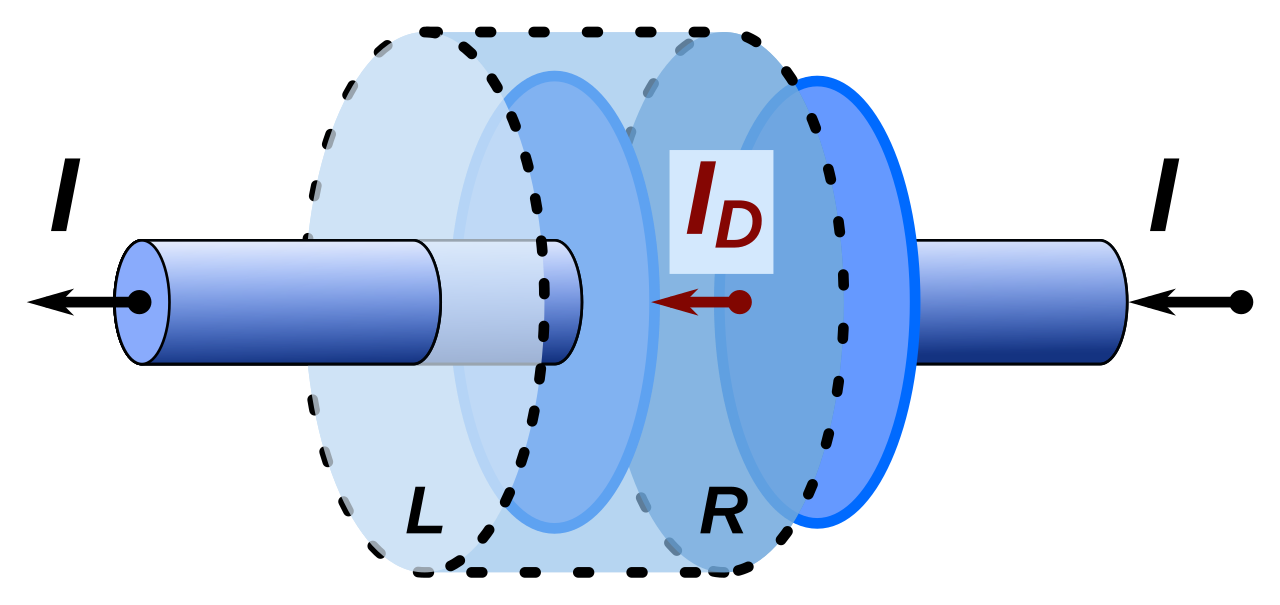
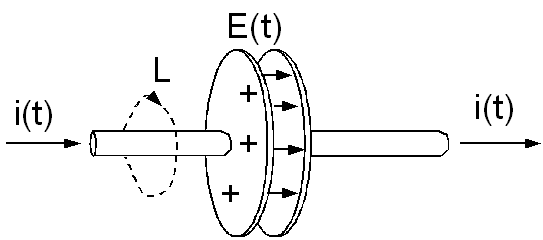
One of the most striking features of displacement current density is that, despite carrying the same units as ordinary electric current density and acting as a source of magnetic fields in exactly the way a conduction current does, it does not involve the transport of free charges through space. Instead, it arises purely from the time-varying electric field. In the mathematical expression for JD, the first term—ε0 times the partial derivative of E with respect to time—is present both in vacuum and in material media. It generates an associated magnetic field just as a current of moving charges would, yet no individual electron or ion need be in transit. Some authors reserve the label displacement current for this first term alone, distinguishing it from the second term that accounts for molecular polarization. This conceptual separation is important: the vacuum contribution is not a flow of matter, but a field effect that nonetheless obeys the same magnetic-field-producing role as any other current term in Maxwell's equations.
Polarization Current and the Role of Bound Charges
When displacement current density is evaluated inside a physical dielectric rather than in empty space, a second contribution appears: the time derivative of the polarization vector P. This term, often called the polarization current density, reflects the tiny displacements of positive and negative charges within individual molecules as an applied electric field pulls them slightly apart from their positions of exact cancellation. As the field changes, the degree of separation shifts, and that shifting constitutes a genuine movement of charge at the molecular scale, making it equivalent to a current in the conventional sense. Maxwell himself did not draw a sharp boundary between vacuum and matter; he treated the vacuum as simply another material medium whose effect was to alter the relative permittivity εr in the relation D = ε0εr E. In his original 1861 conception, the displacement current was precisely this polarization effect in a dielectric, and the vacuum case was merely a special limit of the same physical picture.
Completing the Equations and the Birth of Electromagnetic Waves
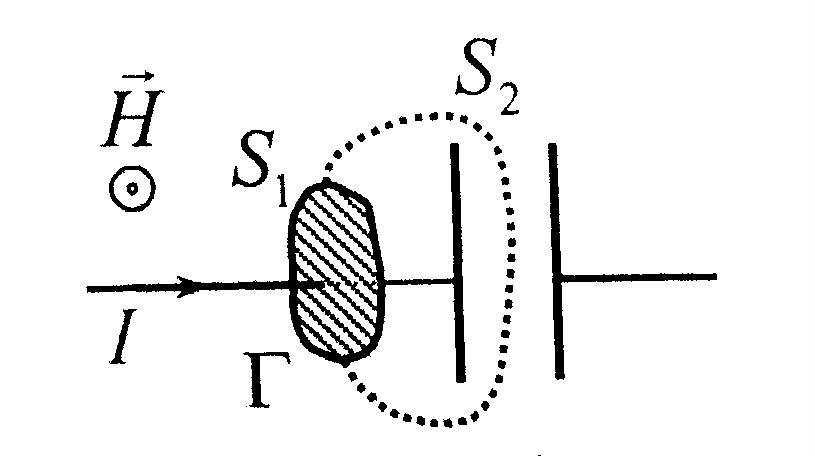
The displacement current term is now universally regarded as the crucial addition that brought Maxwell's equations to their complete form. Without it, the set of equations governing electricity and magnetism would fail to account for a vast range of observed phenomena, most notably the existence and propagation of electromagnetic waves. In integral form, the displacement current through any surface S equals the time derivative of the electric displacement flux ΦD through that surface, tying the local field behavior to a global conservation-like statement. This term ensures that the equations remain consistent in situations where no conduction current crosses a surface but the electric field is nonetheless changing—precisely the condition under which a wave propagates through empty space. The 1865 derivation of the wave equation from the amended Ampère's law demonstrated that light itself is an electromagnetic phenomenon, unifying optics with the rest of the field theory and establishing a foundation that would shape every subsequent development in physics.
Gallery
Frequently Asked Questions
Who is Displacement current density?
Displacement current density is the term ∂D/∂t that appears in Maxwell's equations, quantifying how rapidly the electric displacement field changes at a given point. It shares the same physical units as ordinary current density, yet no charges are actually flowing—it is a purely field-theoretic quantity.
What are Displacement current density's powers and role?
Its signature ability is generating a magnetic field in exactly the same way conduction current does, which is what lets Ampère's circuital law remain valid when fields change with time. In real materials it also picks up a small extra contribution from bound charges shifting slightly inside atoms, a process known as dielectric polarization.
How does Displacement current density's story end?
Its narrative arc culminates in the completion of Ampère's law, which in turn makes the full Maxwell system self-consistent. That consistency is precisely what allows the electromagnetic wave equation to emerge, so its 'ending' is the theoretical birth of light, radio, and the entire spectrum of radiation.
Why is Displacement current density important?
Without this term, Maxwell's equations would violate charge conservation and electromagnetic waves would simply not appear in the theory. It is the single bridge between static electrostatics and the full richness of propagating radiation.
Is Displacement current density actually a current?
Despite the name, no individual charges are in transit; it is the time-derivative of the electric displacement field, not a flow of particles. It reproduces the magnetic-field-producing effect of real current, which is why Maxwell introduced it, but physically it is a field effect rather than a particle motion.
More in Electricity And Magnetism 1-24
Elsewhere in the Electricity And Magnetism universe
Spotted an error? Know more?
This is a living reference — every entry is fact-audited, and reader corrections feed straight into our audit queue. Suggest an edit · See this site's audit record