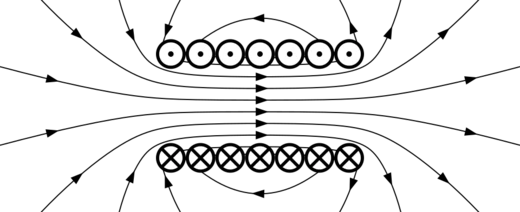
Faraday's law of induction
Law describing how changing magnetic fields induce electric currents.

Faraday's law of induction describes how a changing magnetic field can induce an electric current in a circuit. This phenomenon, known as electromagnetic induction, is the fundamental operating principle of transformers, inductors, and many types of electric motors, generators and solenoids. The law is used to refer to two closely related but technically distinct statements: the Maxwell–Faraday equation, which states that a time-varying magnetic field is always accompanied by a circulating electric field, and the Faraday flux rule, which relates the electromotive force around a closed conducting loop to the time rate of change of magnetic flux through the loop.
- field
- Electromagnetism
- known_for
- Electromagnetic induction, Faraday's law of induction
- key_figures
- Michael Faraday, Joseph Henry, Emil Lenz, Franz Ernst Neumann, Wilhelm Eduard Weber, Riccardo Felici, James Clerk Maxwell, Oliver Heaviside
Lore & Background
In 1820, Hans Christian Ørsted demonstrated that an electric current produces a magnetic field, prompting scientists to ask whether a magnetic field could generate an electric current. He later observed transient currents when moving a bar magnet into a coil and built a homopolar generator producing steady DC current by rotating a copper disk near a stationary magnet.
Reader's Guide
Faraday's law of induction is central to electromagnetism, providing the basis for transformers, inductors, electric motors, generators, and solenoids. Historically, the differing explanations for motional emf and transformer emf posed a conceptual problem, resolved in special relativity as frame-dependent: what appears as a magnetic force in one frame may appear as an induced electric field in another. The law has two formulations: the Maxwell–Faraday equation, which applies to fields without requiring a physical circuit, and the Faraday flux rule, which relates emf to the rate of change of magnetic flux through a closed loop. Lenz's law gives the direction of induced emf. Oliver Heaviside later referred to the differential equation form as Faraday's law, which is the version recognized today in Maxwell's equations.
Did You Know?
- Faraday's law of induction describes how a changing magnetic field can induce an electric current in a circuit.
- The law is used to refer to two distinct statements: the Maxwell–Faraday equation and the Faraday flux rule.
More in Electricity And Magnetism 1-24
Elsewhere in the Electricity And Magnetism universe
Spotted an error? Know more?
This is a living reference — every entry is fact-audited, and reader corrections feed straight into our audit queue. Suggest an edit · See this site's audit record